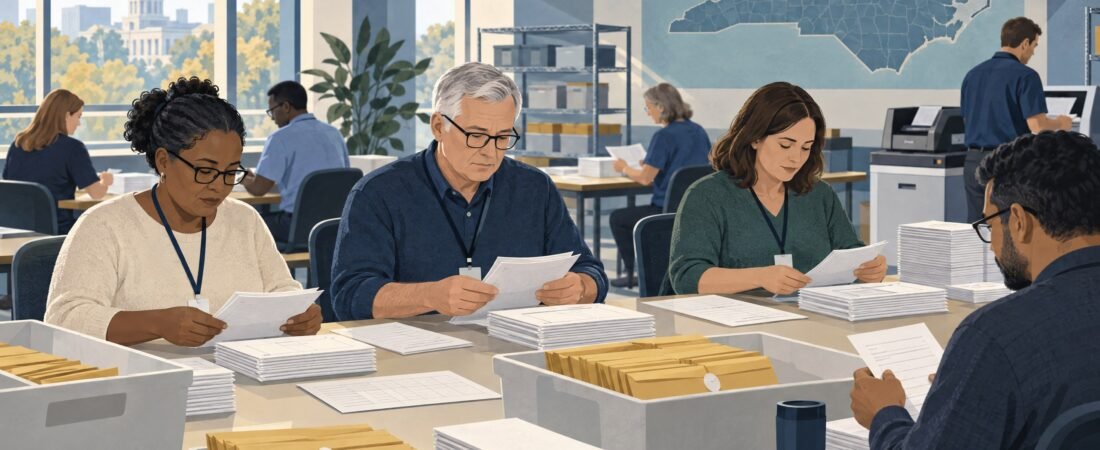
North Carolina election results from Nov. 3, 2026, remain unofficial as of Nov. 5. County officials are reviewing provisional and cured absentee ballots, carrying out a required public sample hand-count audit and preparing to canvass results on Nov. 13. The State Board’s statewide canvass is scheduled for Nov. 24. Candidate-initiated recount demands follow canvass and must meet statutory conditions. North Carolina election officials say the results may still change during this process; local reporting has likewise explained that election-night totals are not the official count.WCNC
Here is what remains to be counted, how the audit works and the deadlines that matter next.
The facts: North Carolina election results are still under review
County boards must review provisional ballots by Tuesday, Nov. 10. A voter who needs to cure an absentee ballot must deliver the required document by noon that day. Challenges to absentee ballots are due by 5 p.m. Nov. 10. Eligible military and overseas ballots mailed by Election Day can arrive at county election offices through 5 p.m. Nov. 12 and be included in the county canvass.
The State Board’s Nov. 4 release reports how many provisional ballots were cast in each county. It does not say how many will ultimately be approved or rejected. County boards make those eligibility decisions during the canvass period. The state’s county-by-county provisional-ballot release and its post-election schedule set out those separate steps.
The facts: what North Carolina’s post-election audit checks
The State Board randomly selects two voting groups in each of North Carolina’s 100 counties for a public sample hand-count audit. For the 2026 general election, county boards hand-count the U.S. Senate contest in those selected groups and compare the hand totals with machine counts. The audit is a sample check; it is not a recount of every ballot or a decision about which candidate won.
The State Board announced the sampling process on Nov. 3 and describes the broader post-election audit and canvass procedures on its website. Current reporting has also explained how the required hand-count audit fits into the timetable. WCNC’s process explainer describes the audit and the distinction between unofficial totals and certified results.
The facts: county and state canvasses have different roles
All county boards are scheduled to meet at 11 a.m. Friday, Nov. 13. They complete the canvass, certify contests under county jurisdiction and authenticate results for contests overseen by the State Board. The statewide canvass is scheduled for 11 a.m. Tuesday, Nov. 24.
Canvassing is the formal review that brings together the eligible ballots, required checks and county results. The State Board’s timetable says election-night totals remain unofficial until the canvass and certification process is complete. WUNC’s Nov. 4 report on close North Carolina contests also cautioned that provisional, cured absentee and military or overseas ballots could change preliminary margins before canvass.
The facts: when a recount may be requested
A recount is not automatic. Under North Carolina General Statutes § 163-182.7, a candidate in a nonstatewide contest may demand a recount when the margin is 1% or less of the votes cast. For a statewide ballot item, the threshold is 0.5% or 10,000 votes, whichever is less. Candidate demands follow canvass; the law also allows a recount when needed to complete a canvass.
The State Board’s 2026 timetable sets the filing deadlines: a demand for a county-jurisdiction contest must reach the county board by 5 p.m. Monday, Nov. 16. A demand for a State Board-jurisdiction contest—including a legislative district spanning more than one county—must reach the State Board by noon Tuesday, Nov. 17. WRAL’s reporting on the recount timetable describes the deadlines and the outstanding ballot review; it does not treat a possible recount as a final result.
Analysis: a close or delayed count is not a finding of wrongdoing
The sequence matters because a narrow election-night margin is not the same as a certified outcome. Officials still have to decide which provisional and cured absentee ballots qualify, include eligible military and overseas ballots, compare a sample of hand-counted ballots with machine totals, and complete the canvass.
The audit and a recount answer different questions. The sample audit checks whether hand counts of selected voting groups match machine totals. A recount is a separate, contest-specific legal process that may be requested after canvass if the margin and filing rules allow it. Neither a scheduled audit nor a close margin, by itself, establishes an error or misconduct. The useful signal for readers is the official record: which ballots were accepted, whether the required checks are complete, and whether an eligible candidate files a timely recount demand.
What happens next
- Nov. 10: County review of provisional ballots; noon deadline for remaining absentee-ballot cure documents; 5 p.m. deadline for voter-filed absentee challenges.
- Nov. 12, 5 p.m.: Deadline for eligible military and overseas ballots to arrive for inclusion in the canvass.
- Nov. 13, 11 a.m.: County canvass meetings and certification of county-jurisdiction contests.
- Nov. 16, 5 p.m. and Nov. 17, noon: Recount-request deadlines for county and State Board contests, respectively.
- Nov. 24, 11 a.m.: Scheduled State Board canvass.
Bottom line
Until the canvass is complete, North Carolina election results remain unofficial. The next clear checkpoints are the county and State Board meetings, plus any eligible recount demand submitted by the deadline. Readers should compare updates with State Board notices and certified canvass records rather than rely on election-night margins. The calendar provides a defined path from ballot review to certification; it does not predict which contests will require a recount or imply a problem with the vote.
For background, see The Brief Lens’s report on 2026 early-voting totals and its separate coverage of the Supreme Court ruling on California ballot counting. Those stories cover earlier turnout and a different state’s court dispute; they do not replace North Carolina’s official canvass updates. Read our editorial policy for how The Brief Lens handles election reporting.
Sources and documents
- North Carolina State Board of Elections: What’s Next for Finalizing 2026 Midterm Elections?
- North Carolina State Board of Elections: Provisional ballots by county
- North Carolina State Board of Elections: Post-election audit ballot-group selection
- North Carolina General Statutes, Chapter 163, § 163-182.7
- WCNC: North Carolina election results and when they become official
- WUNC: Close North Carolina contests, provisional ballots and recounts
- WRAL: North Carolina canvass and recount timetable