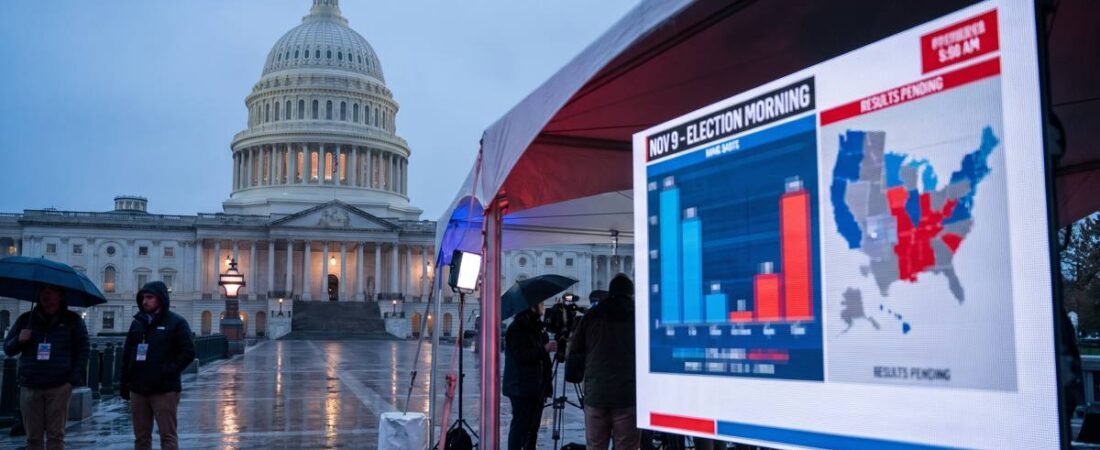
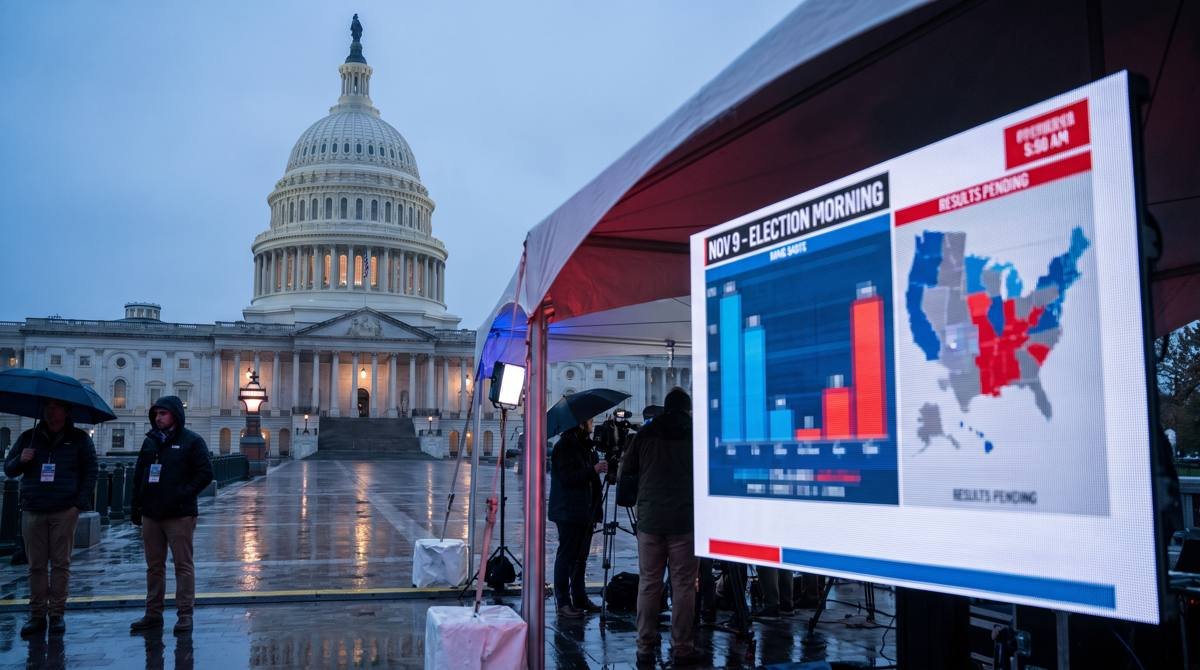
The central result of the November 3, 2026, election is a projected Democratic takeover of both chambers of Congress. The shift would give Democrats control of the House and Senate for the first time since 2023, putting President Donald Trump’s final two years in office under divided government and sharply changing the balance of power in Washington.
Facts: The Associated Press reported that Democrats won control of both chambers, while NPR said its conclusion was based on race calls by the AP. Reuters reported that Democrats had secured at least 54 Senate seats to Republicans’ 44 and had gained at least 28 House seats. Two Senate contests, in Alaska and Mississippi, remained uncalled in Reuters’ November 4 wrap-up. State canvassing and certification were also still pending in at least some jurisdictions.
Analysis: The result is more than a change in party labels. It is a change in who controls committees, subpoenas, nominations and the legislative agenda. Democrats will be able to block the routine confirmation of nominees in the Senate, while House committees are expected to intensify oversight of the Trump administration. Yet the president retains the veto, making a period of confrontation and selective bargaining more likely than a straightforward Democratic policy reset.
The Senate map moved sharply toward Democrats
Democrats’ Senate victory came through a series of Republican-held seats that had not all been considered likely Democratic pickups. Reuters identified wins in deeply Republican or Republican-leaning states, including Texas, Ohio, Kansas, Iowa, North Carolina and South Carolina. AP also reported Democratic victories by James Talarico in Texas and Annie Andrews in South Carolina, along with Sherrod Brown’s return in Ohio and Adam Hamilton’s win in Kansas.
The Texas result was especially significant. Talarico defeated Republican Ken Paxton in a race that AP described as the most expensive Senate contest in the country. No Democrat had won statewide office in Texas for more than three decades, according to AP’s account. In South Carolina, Andrews defeated Darline Graham for a seat Republicans had held since Strom Thurmond switched parties in 1964.
The exact final Senate margin is not yet available. Reuters said Alaska and Mississippi were still outstanding, and AP reported that litigation in Alaska could affect certification if Republican incumbent Dan Sullivan lost. That means the broad conclusion—Democrats will control the Senate—can be reported, but the final seat total should not be treated as settled until the remaining races are called and certified.
House control gives Democrats the investigative power
The House change was also broad. NPR reported Democratic pickups in Florida, Kentucky and Pennsylvania, including seats on maps that Republican state lawmakers had redrawn to favor the GOP. CNN reported that Democrats held or won several Florida districts after Republicans attempted to make the state’s congressional map more favorable to their candidates.
The House majority is expected to elevate Democratic Leader Hakeem Jeffries to the speakership. Reuters noted that Jeffries would be the first Black American to hold the powerful office if elected by the new House. His position would give Democrats control over committee chairs, the floor schedule and the direction of investigations.
Facts: The House result was still a count-in-progress rather than a fully certified total. Reuters described Democratic gains of at least 28 seats, while AP said multiple races were still being resolved. The practical majority is clear, but the final number of Democratic and Republican seats can change as remaining votes are counted and any recounts or canvassing disputes are completed.
Analysis: House control is likely to matter most through oversight. Democrats have signaled investigations into the administration’s conduct, agency independence and the president’s business interests. Those investigations could produce hearings and subpoenas even when Democrats cannot enact their preferred bills. The House majority also gives the party a platform to define the national debate ahead of the 2028 presidential election.
Election administration remains part of the story
The political result is projected, not yet identical to a certified result. Minnesota’s official election-results site states that results for state and federal offices are unofficial until the State Canvassing Board meets on November 19. It also says county results remain unofficial until county canvassing boards meet and that recounts can be requested after canvassing. The state’s notice is a reminder that election-night calls and legal certification are separate steps.
The same distinction matters in Alaska and Mississippi, where the Senate races were still uncalled as of Reuters’ November 4 report. It also matters in any close House contest where provisional ballots, late-arriving ballots allowed under state law, recounts or litigation could affect the final tally. None of those procedures, by themselves, overturns the projected congressional outcome; they determine the official totals and the precise margin.
What divided government means next
NPR reported that Trump had already said he would become “Mr. Veto” if Democrats won Congress, although he also suggested that deals could eventually be possible. The president’s veto power means Democrats will need Republican support, or a compromise with the White House, to turn major legislation into law.
The Senate’s role will be immediate. A Democratic majority can halt or slow the confirmation of Trump’s judicial and executive nominees, and Cabinet nominees may need Democratic votes to take office permanently. Congress will also have to pass annual funding legislation, creating pressure for negotiations even as the parties fight over investigations and policy.
For voters, the most important takeaway from the 2026 midterm election results is therefore twofold: Democrats have won the institutional power to investigate and obstruct, but not the unilateral power to legislate. The remaining uncalled races and pending certifications will refine the numbers. They are unlikely to change the basic political fact that the final two years of Trump’s term will begin with Democrats controlling both chambers of Congress.