As of Nov. 8, 2026, Minnesota’s results remain unofficial and counties are canvassing them. The 2026 post-election review has not started: state law bars it before Nov. 12 and requires selected-precinct hand counts to finish by Nov. 17, ahead of the State Canvassing Board’s scheduled Nov. 19 certification. Those public checks compare paper-ballot totals with optical-scan results; they are not a recount of every ballot. In the close 1st Congressional District race, preliminary state figures put Democrat Jake Johnson 323 votes ahead of Republican incumbent Brad Finstad.
The immediate story is not a new result. It is the scheduled verification process between election night and certification. Minnesota’s rules require officials to compare hand-counted ballots in selected precincts with optical-scan totals. The law treats that sample-based check separately from a candidate-requested recount, which follows the canvass when a race meets the statutory threshold.
Facts: Minnesota’s results are not final yet
The Minnesota Secretary of State’s Nov. 4 election-results notice says unofficial results reported by counties include combined totals from Election Day, early voting, absentee ballots and mail ballots. The state does not present those totals as separate voting-method counts on its main results reporting. County canvassing boards must first review and canvass the returns for county, state and federal candidates.
The State Canvassing Board is scheduled to meet on Thursday, Nov. 19, 2026. That meeting is when Minnesota says results for state and federal candidates will become official. Until then, a projected or unofficial lead is not the same thing as a certified result. Municipal and school-district contests follow their own canvassing schedules.
The state’s official participation release says more than 2.8 million Minnesotans cast ballots, exceeding the state’s previous midterm participation record from 2018. It also describes a preliminary University of Florida Election Lab estimate that Minnesota had the nation’s highest participation rate. That comparison is an estimate, not a final certified turnout statistic.
The same release identifies four contests within Minnesota’s publicly funded recount margins. In the 1st Congressional District, Johnson was listed with 163,056 votes to Finstad’s 162,733, a difference of 323 votes, or 0.1 percent. The release says the State Canvassing Board will certify that race on Nov. 19 at 2 p.m.
A Rochester Post Bulletin report published Nov. 4 also described the race as a 323-vote contest and said Finstad had not confirmed at that time whether he would seek a recount. As of Nov. 8, the request window has not opened because the results remain unofficial. A margin within the recount range is not itself a request or an order.
Facts: What Minnesota’s post-election review does
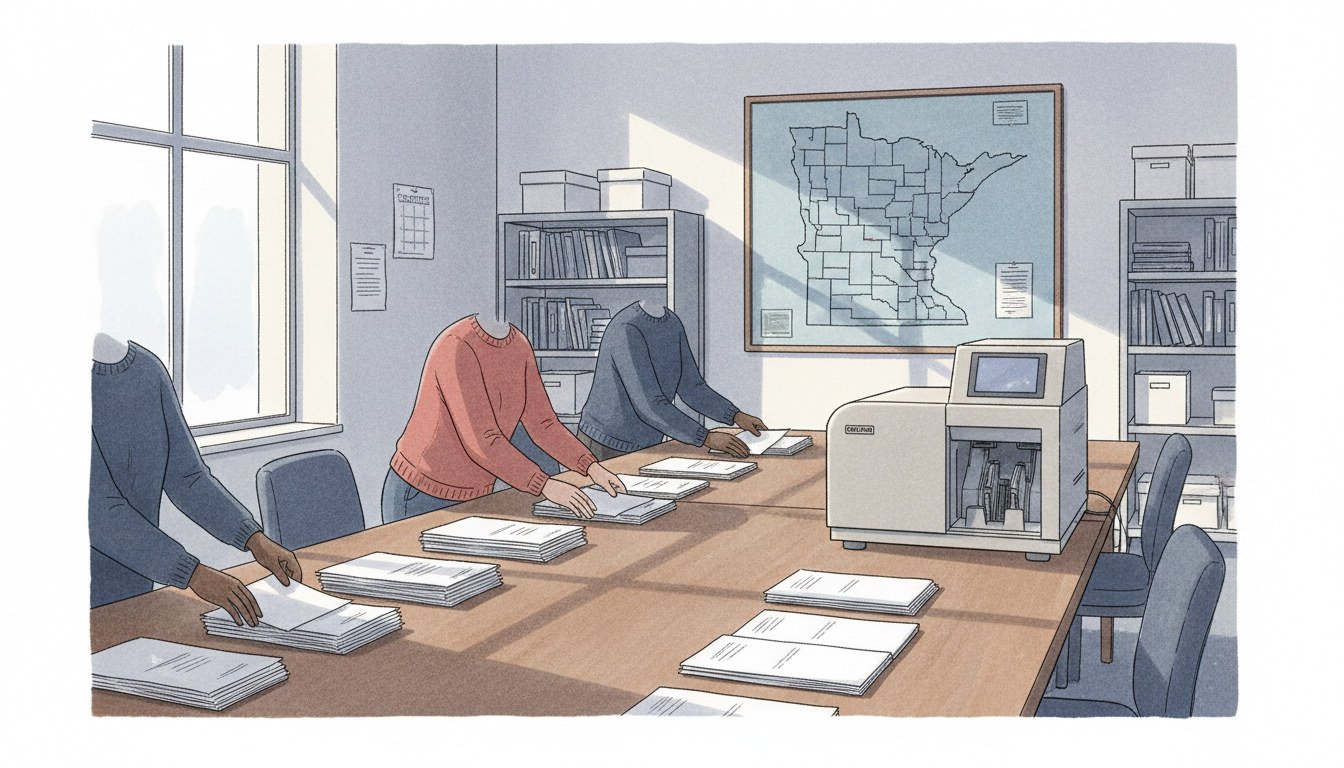
Minnesota’s post-election review guidance and Statute 206.89 require counties to conduct public hand counts in randomly selected precincts after a state general election. Officials compare those paper-ballot counts with the optical-scan totals from the same precincts.
For 2026, the Secretary of State identifies the U.S. Senate, U.S. House and governor contests for review. The statute provides an exception when an office’s election will be subject to a publicly funded recount. The 1st District’s preliminary margin falls within the recount range, but the state says the results are not official until Nov. 19 and the recount request window follows canvassing. The review schedule alone does not establish that a recount has been requested or that this particular race will be counted under both procedures. Each county’s canvassing board selects review precincts by lot and must notify the Secretary of State of the time, place and precincts chosen.
The required sample depends on the county’s registered-voter population. Counties with fewer than 50,000 registered voters must review at least two precincts. Counties with 50,000 to 100,000 registered voters must review at least three. Counties with more than 100,000 registered voters must review at least four precincts or 3 percent of the county’s precincts, whichever is greater. At least one selected precinct in each county must have had more than 150 votes cast.
The state also describes a separate post-election performance review. The Secretary of State must evaluate election procedures in the precincts reviewed, with at least four precincts in each congressional district selected by lot by the State Canvassing Board. That is different from deciding which candidate wins a close race. The hand-count review tests whether voting-system totals match the ballots in the sample; it does not itself replace the canvass or automatically trigger a recount.
A St. Cloud Times explainer likewise reported that selected precincts will be publicly hand-counted for governor and lieutenant governor, U.S. senator and U.S. representative before certification.
Analysis: Why the review matters in a close race
The review will give voters a visible checkpoint between unofficial results and certification. It can identify discrepancies that officials must examine, while showing how a paper-ballot sample compares with machine totals. Because the procedure covers selected precincts rather than every precinct, it should not be described as a full recount or as a guarantee that every ballot has been manually re-tallied.
That distinction is especially important in the 1st District. The official state release lists the 323-vote, 0.1% margin within the publicly funded recount range. Minnesota Statute 204C.35 sets the federal-office threshold at less than one-quarter of 1% of votes counted. It requires a written request after the canvass; for a general election, the request is due by 5 p.m. on the second day after the canvass. The state’s preliminary margin is not itself a recount order.
The Rochester Post Bulletin noted that a manual recount can resolve ballots that an optical scanner cannot read cleanly, such as marks outside a voting oval. That is one reason a recount can change a small number of votes even when voting equipment is functioning as designed. It does not mean that a close margin or a sample review is evidence of wrongdoing.
Minnesota election officials therefore face separate tasks. County and state canvassing boards must reconcile returns and certify the official totals. The post-election review will compare selected hand counts with machine results, subject to the statutory recount exception. If an eligible recount is requested after certification, officials will conduct that separate review under the recount rules. For comparison, The Brief Lens’ South Carolina recount report describes a different threshold-based process. Our California ballot ruling coverage covers another, separate election-administration dispute.
As of Nov. 8, 2026, Minnesota’s results remain unofficial, the Nov. 19 state certification meeting is scheduled, and the 1st District recount request window has not opened. Any claim that Johnson or Finstad has a certified win, or that a recount is already underway, would go beyond the verified record.
Sources
- Minnesota Secretary of State: Unofficial 2026 Election Results Reported Starting After 8 p.m.
- Minnesota Secretary of State: Post-election reviews
- Minnesota Secretary of State: Historic Voter Participation in 2026 Statewide Election
- Minnesota Statutes §206.89: Postelection review of voting systems
- Minnesota Statutes §204C.35: Federal, state and judicial recounts
- Rochester Post Bulletin: What happens next in the Jake Johnson and Brad Finstad race?
- St. Cloud Times: When will the Nov. 3 election be certified in Minnesota?