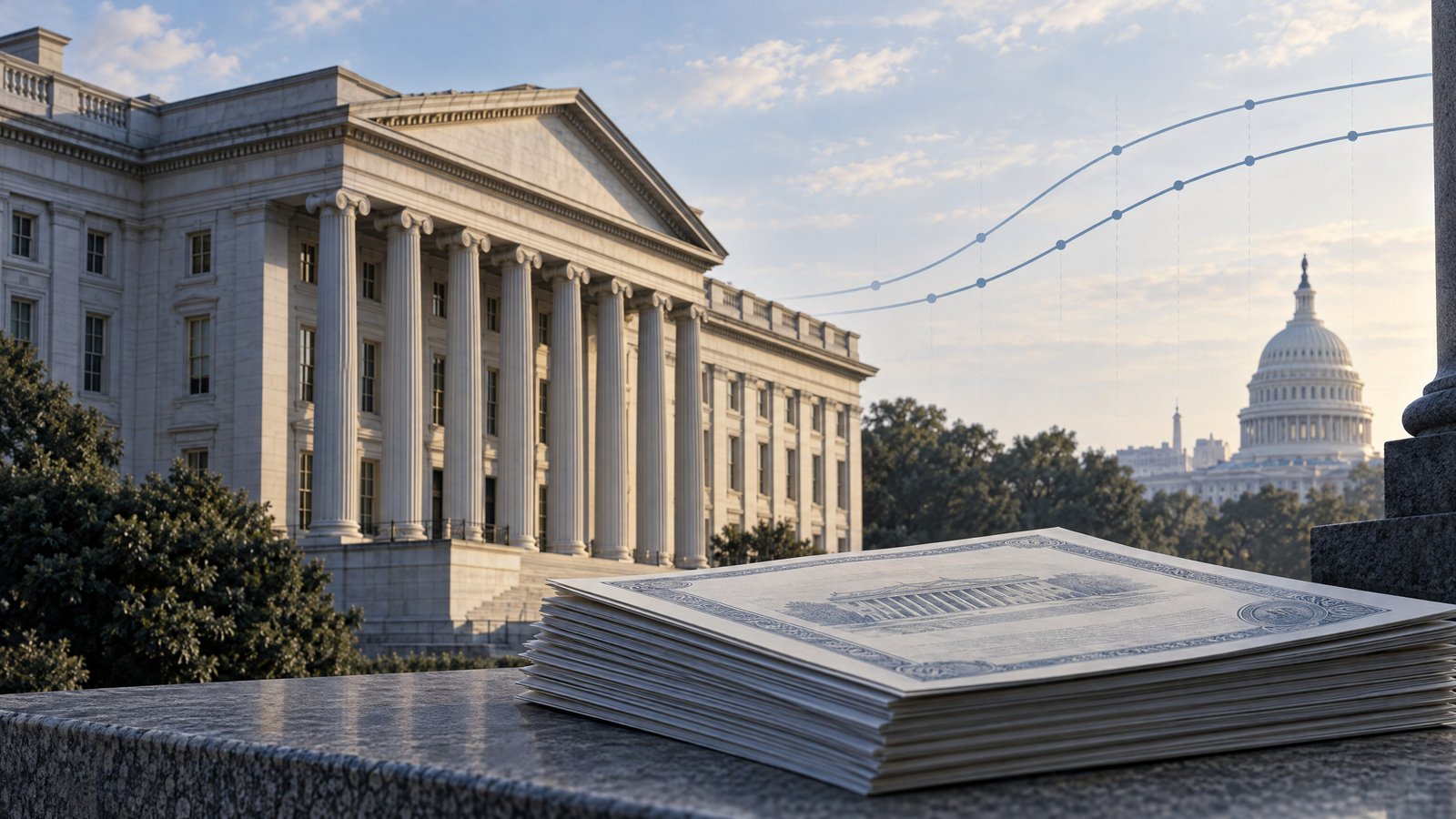
Treasury’s latest borrowing and bond-auction plan projects $618 billion in privately held net borrowing from October through December 2026 and $800 billion in January–March 2027. It keeps most coupon-auction sizes steady for the next few months, while the Treasury Borrowing Advisory Committee warns that higher financing needs could require larger auctions later in fiscal 2027.
The plan is a financing estimate and auction schedule, not a tax or spending law. Its political effect is to make borrowing costs visible as Congress and the White House debate taxes, spending and interest-rate pressures. As of Nov. 8, 2026, the estimates and November auctions are official; future auction changes and their effect on rates remain conditional.
Facts: Treasury’s borrowing plan and November refunding
On Nov. 2, the U.S. Department of the Treasury estimated that it would issue $618 billion in privately held net marketable debt during the October–December quarter. The estimate assumes an end-of-December Treasury cash balance of $850 billion. It is $10 billion below the department’s August estimate, mainly because Treasury began the quarter with more cash than previously assumed. When that starting-cash difference is removed, however, the current estimate is $24 billion higher than the earlier projection. Treasury borrowing estimate
Treasury projected $800 billion of privately held net marketable borrowing for January–March 2027, assuming a $1 trillion end-of-March cash balance. The department borrowed $742 billion in the July–September quarter and ended that period with $984 billion in cash. “Privately held net marketable borrowing” excludes rollovers of securities held by the Federal Reserve’s System Open Market Account, but it includes financing associated with redemptions.
On Nov. 4, Treasury announced a $125 billion November refunding operation. About $97 billion will replace privately held notes and bonds maturing Nov. 15, leaving approximately $28 billion in new cash. The offering consists of a $58 billion three-year note, a $42 billion 10-year note and a $25 billion 30-year bond. The auctions are scheduled for Nov. 9, 10 and 12, respectively. Treasury quarterly refunding statement
Treasury said it expects to maintain nominal coupon and floating-rate-note auction sizes for the next several quarters. The table keeps the November–January sizes for the main maturities broadly at recent levels: $69 billion for two-year notes, $58 billion for three-year notes, $70 billion for five-year notes, $44 billion for seven-year notes, $42 billion for November’s 10-year note and $25 billion for November’s 30-year bond. Treasury will use bill auctions and cash-management bills to handle seasonal or unexpected changes in cash needs.
The department also plans to convert the seven-year note from a monthly new issue into a quarterly new issue with two reopenings. That change begins with the March 2027 new issue. Treasury additionally plans to buy up to $70 billion of older, “off-the-run” securities for liquidity support and up to $25 billion of shorter-maturity securities for cash management during the quarter.
The Treasury Borrowing Advisory Committee, an outside advisory group, described a wider challenge. Its Nov. 4 report said the funding gap is expected to widen in fiscal years 2027 through 2029. The committee recommended leaving current auction sizes unchanged for this quarter but said increases in coupon-auction sizes will likely be warranted later in fiscal 2027. It also urged Congress to raise or suspend the debt limit to avoid disruption to Treasury markets, higher taxpayer costs and constraints on economic growth. The committee’s recommendation is advisory; it is not a law or a binding Treasury order. TBAC report
Facts: How rates and inflation affect the Treasury borrowing plan
Debt issuance takes place while borrowing costs are elevated. The Federal Reserve said on Oct. 28 that it would hold the federal funds target range at 3.75% to 4%, while noting that inflation remained elevated and that its 2% goal had not yet been reached. Two members preferred a quarter-point increase. Federal Reserve statement For related context, see The Brief Lens’ report on the latest Fed rate signal.
The Bureau of Labor Statistics reported that consumer prices were 3.7% higher in September than a year earlier. Energy rose 20.4%, while core inflation excluding food and energy was 2.6%. These are consumer-price measures, not the interest rate Treasury pays on a security, but they help explain why markets watch future rate decisions. BLS CPI release
The Congressional Budget Office’s February baseline projected about $1 trillion in 2026 net interest outlays, or 3.3% of GDP, and public debt rising from 101% of GDP in 2026 to 120% in 2036. It reflects laws in place for that estimate, so it is a benchmark rather than a current forecast. CBO budget outlook
Analysis: The political choices behind the bond calendar
The immediate decision is narrower than the coming budget debate: Treasury says current auction sizes are adequate for the near term. The political question is what Congress and the administration do if tax and spending choices keep borrowing needs high.
Keeping coupon sizes steady makes the near-term supply plan more predictable, but it does not eliminate the funding need. Treasury’s estimates imply $1.418 trillion in privately held net marketable borrowing across the next two quarters, subject to revisions in receipts, spending and cash balances. The new Congress’s broader tax and spending choices are covered in The Brief Lens’ post-midterm economic agenda analysis.
The committee’s warning about later coupon increases creates a second political pressure point. Larger sales of two- to 10-year notes, or changes at the long end, could affect yields and the cost of mortgages, business loans and other credit. Reuters reported that dealers were watching for possible future reductions in 20- and 30-year issuance and greater reliance on bills or shorter maturities. That was market analysis, not an announced Treasury decision. Reuters on auction expectations
A shorter maturity mix can lower costs in the near term but exposes the government to more frequent refinancing. Longer maturities can lock in funding but may carry higher yields. Treasury’s stated standard is to finance the government at the lowest cost over time while balancing cost and interest-rate risk. Taxpayers ultimately bear the interest expense.
Congress also controls taxes, spending and the statutory debt limit. The TBAC urged lawmakers to raise or suspend the limit to avoid market disruption, higher taxpayer costs and constraints on growth. That is a policy warning, not a prediction of imminent default. A debt-limit fight could add uncertainty to Treasury payments and auctions.
The new Congress and the White House will face the policy choices behind the borrowing plan. Slower spending growth, higher revenue or program changes could restrain deficits; new spending without offsets could increase issuance needs. The November refunding does not choose among those options. It shows how their financing costs enter the debate.
Sources
- U.S. Treasury, Nov. 2 borrowing estimates
- U.S. Treasury, Nov. 4 quarterly refunding statement
- Treasury Borrowing Advisory Committee, Nov. 4 report
- Federal Reserve, Oct. 28 FOMC statement
- Bureau of Labor Statistics, September 2026 CPI
- Congressional Budget Office, The Budget and Economic Outlook: 2026 to 2036
- Reuters, Treasury auction changes and 2027 dealer expectations
- Reuters, Treasury cuts fourth-quarter borrowing estimate