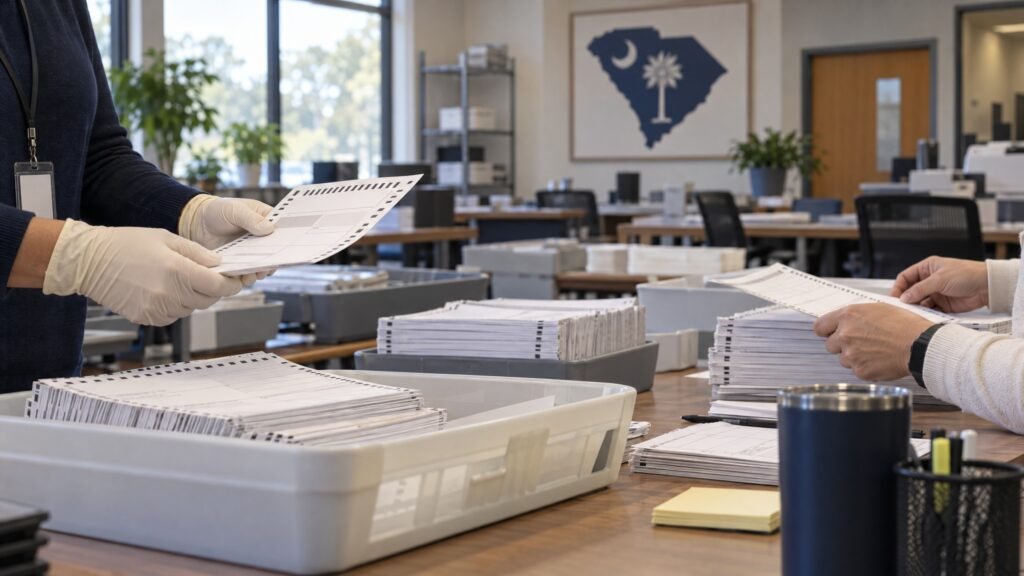
South Carolina’s U.S. House District 2 contest is poised for a mandatory recount, but no statewide recount had yet been ordered as of Nov. 7, 2026. WACH reported that the county-certified tally put Republican Rep. Joe Wilson 0.99 percentage points ahead of Democrat Zyon Khalifa, just inside South Carolina’s 1% recount trigger. The State Election Commission’s scheduled Nov. 10 canvass is the next formal step; the Commission says any necessary recounts will be ordered after official results are certified.
Facts: The reported margin is just inside South Carolina’s rule
Wilson and Khalifa are competing for the U.S. House seat in South Carolina’s 2nd Congressional District. On Friday, Nov. 6, WACH reported that Khalifa said the certified results showed Wilson ahead by 0.99 percentage points. The same report said two state House races also were headed toward recounts. These are post-election canvass developments, not a final recount result. WACH’s report
The margin moved as local officials completed their canvass. On Nov. 4, WIS-TV quoted South Carolina Election Commission Executive Director Conway Belangia saying the unofficial Wilson-Khalifa difference was still slightly above 1%. Belangia said county certification was needed before officials could determine whether a recount was required. The later 0.99-point figure reported by WACH therefore reflects a different stage of the count, not proof that a recount has already changed the result. WIS-TV’s earlier report
South Carolina’s Election Commission explains that election-night results are unofficial. County boards add eligible provisional ballots during canvassing and certify their returns; the State Election Commission then certifies the statewide results. The Commission’s voter FAQ says results become official after election officials determine that all votes have been counted accurately and completely.
Facts: State law makes a recount mandatory at 1% or less
Under South Carolina Code Section 7-17-280, when the difference between a candidate declared elected and another candidate is no more than 1% of the votes cast for that office, the board responsible for canvassing the vote must order a recount “forthwith,” unless the other candidate or candidates waive it in writing. The law sets a threshold; it does not require a candidate to prove misconduct or allege that ballots were mishandled.
The calculation is tied to votes cast for the particular office, not statewide turnout. The State Election Commission’s FAQ gives the example that a 100-vote gap in a race with 10,000 votes would meet the 1% threshold. WJCL’s recount explainer likewise explains that the comparison uses total votes cast in the contest.
The next step is the state canvass. State law makes the South Carolina Election Commission the Board of State Canvassers and directs it to meet within 10 days of a general election to canvass the votes for all offices. The Commission’s 2026 election calendar schedules the board’s canvass and certification for Tuesday, Nov. 10. The Commission also told ColaDaily that it planned to certify results for U.S. House districts that day and order any recounts required by the official totals. ColaDaily’s report
That distinction matters: a reported margin near the threshold is not itself a completed recount. As of Nov. 7, the formal state canvass and certification were still ahead. The officials’ decision on Nov. 10 will determine whether the reported margin remains within the legal band and whether a recount is ordered. The schedule is a procedural deadline, not a projection of which candidate will prevail.
Analysis: What the recount can—and cannot—settle
If the final canvass confirms a margin of 1% or less, the statute directs election officials to order a recount unless the challenger waives it in writing. A recount can refine or change the reported total, but it does not guarantee that the result will change. Until the review and certification steps are complete, neither a projection nor a candidate’s statement should be treated as the official result.
The threshold is a neutral rule triggered by closeness, not evidence that fraud or other wrongdoing occurred. That is important in a race where supporters of both candidates are monitoring the count. Officials’ job is to apply the same procedure to the complete record, including eligible provisional ballots, and then publish the certified outcome.
The contest will decide who represents the district, even though the Associated Press reported that Democrats had won control of both chambers of Congress. The final count can still affect which party holds this seat and the size of the incoming House majority. For broader context, see The Brief Lens’ coverage of the 2026 House result. South Carolina’s rule also differs from the process in other close Senate races; The Brief Lens’ Mississippi count report explains why that state’s affidavit-ballot count follows a different legal path. AP’s national results report
Sources
- South Carolina Code of Laws, Chapter 17, including Sections 7-17-210, 7-17-220 and 7-17-280
- South Carolina Election Commission voter FAQ
- South Carolina Election Commission 2026 election calendar
- Associated Press: Democrats win the U.S. House and Senate
- WACH: South Carolina congressional race and two state House races headed to recounts
- ColaDaily: No recount yet in South Carolina’s 2nd Congressional District
- WIS-TV: Recount possibility looms in South Carolina’s 2nd Congressional District