Trump’s Housing Order: What It Can—and Can’t—Change
Primary keyword: Trump housing executive order
Secondary keywords: mortgage insurance cancellation; manufactured housing; mortgage rates
Meta description: Trump’s housing executive order targets mortgage insurance, title costs and government loan rates. Here is what is binding—and what still needs work.
Slug: trump-housing-executive-order-mortgage-costs
Dek: The October 22 order could lower selected refinancing and insurance costs, but its larger affordability promises depend on agency design, funding and housing supply.
As housing affordability remains a central concern for American voters, President Donald Trump’s new housing order is being presented as a broad cost-cutting plan. Signed October 22 and published in the Federal Register on October 28, it directs federal housing agencies to test proactive mortgage-insurance cancellation, expand manufactured-housing programs, make a title-insurance alternative permanent and reduce rates on some direct USDA and VA loans.
The practical question is what can change quickly. The clearest savings are concentrated among particular borrowers; home prices, mortgage rates and housing supply remain largely outside the order’s immediate control.
What the order actually does
The order tells FHFA to direct Fannie Mae and Freddie Mac to establish a pilot for mortgages made after it begins. Using automated valuation models and other data, the enterprises would identify borrowers who appear to meet equity, payment-history and other legal requirements for cancellation. Servicers would notify eligible borrowers where feasible.
It also tells FHFA to expand its title-acceptance pilot into an ongoing, nationwide program for eligible refinancings. The program could let the enterprises accept automated title reviews or other approved risk assessments instead of a lender’s title-insurance policy. The order says savings must be passed through to borrowers, but leaves eligibility, providers and fee changes to FHFA.
The other provisions are less immediate. A task force has 180 days to recommend standardized approvals for manufactured and other factory-built homes. USDA and Veterans Affairs are directed to reduce rates on direct single-family loans, subject to law and appropriations.
Most consumer effects require agency design and implementation. The order creates no enforceable private right and says implementation must comply with law and available appropriations.
Where borrowers could see savings
Mortgage insurance is a real monthly cost for buyers who put down less than 20 percent. Fannie Mae says private mortgage insurance commonly costs roughly 0.2 percent to 2 percent of the loan annually, depending on credit and other factors. Conventional borrowers can generally request cancellation at 20 percent equity based on original value, with automatic termination at 78 percent under applicable rules, according to Fannie Mae’s guidance.
The pilot could reduce paperwork and stop some borrowers from paying after their homes appreciate enough to satisfy the threshold. But it targets future enterprise loans—not every mortgage—and does not rewrite FHA insurance rules. Savings will depend on final program rules and servicing systems.
The title change may offer limited, transaction-specific relief. FHFA’s earlier pilot estimated refinance savings of $500 to $1,500 for qualifying loans, according to FHFA’s pilot FAQs. Refinancing helps only households that qualify and have a reason to refinance. With the 30-year fixed mortgage at 7.32 percent on October 22, Freddie Mac’s survey archive shows why many owners lack an attractive window.
Why rates and supply still dominate
The order cannot directly set the typical private 30-year mortgage rate, which reflects Treasury yields, inflation expectations and lender pricing. Reuters reported that the average rate reached 7.40 percent before easing to 7.32 percent, while September contract signings and single-family starts weakened.
The Federal Reserve’s household survey shows the broader problem: 49 percent of renters said they could not afford a monthly mortgage payment, and 68 percent cited an unaffordable down payment as a reason for renting. Only 38 percent of adults said they were satisfied with the cost of housing in their neighborhood. Cutting a fee or an insurance bill can help an eligible owner, but does not by itself lower land prices or create enough homes.
The manufactured-housing task force addresses supply more directly, but its effect is longer term. FHFA says factory-built homes can cost less than site-built homes, yet the enterprises primarily acquire those titled as real property. A St. Louis Fed analysis found manufactured-home denial rates remained 5 to 8 percentage points higher after accounting for borrower differences. Appraisal gaps, property classification and resale concerns are major barriers.
The investor debate is not a substitute for supply
The administration has also linked housing relief to restrictions on large institutional investors. The White House says a January order targeted investors buying homes that families could otherwise purchase. But the evidence is mixed and local. The Government Accountability Office found that institutional investors may have contributed to higher prices and rents in some markets after the financial crisis, while the Urban Institute notes that investor activity varies sharply by place and can include build-to-rent construction.
Investor policy may affect competition in particular neighborhoods, but is unlikely to solve a national shortage alone. Implementation data will matter more than the announcement: insurance cancellations, refinance savings, USDA and VA rates, and manufactured-home financing.
For now, the Trump housing executive order is best understood as a targeted set of agency instructions, not an instant reset of the housing market. It could produce useful savings for qualifying borrowers and remove financing frictions over time. But the affordability problem voters feel is driven most powerfully by the cost of homes, the cost of money and limited supply. Those pressures remain uncertain as of October 28, 2026.
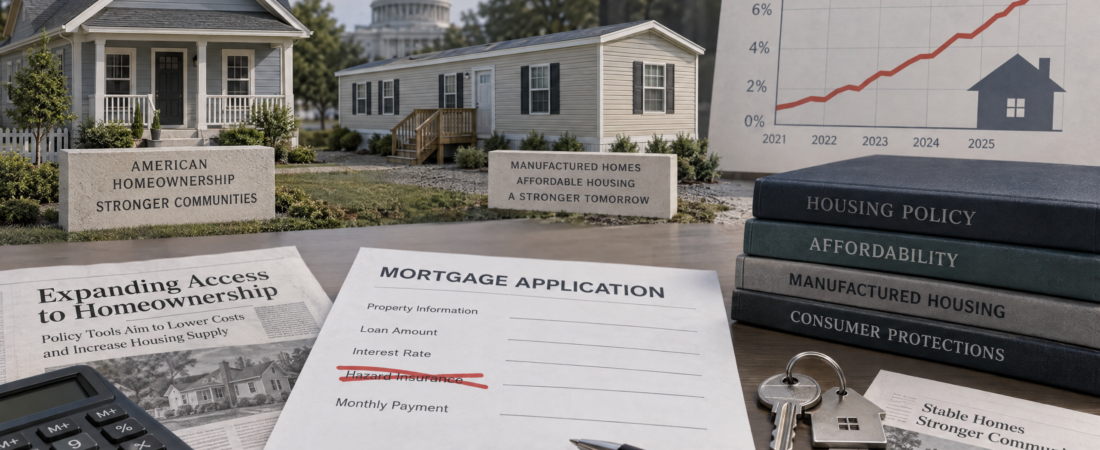
Editorial image prompt
Create a documentary-style editorial illustration, clearly labeled “Illustration,” showing a U.S. starter home, a factory-built manufactured home, mortgage documents with a crossed-out insurance line, and a rising interest-rate graphic on a neutral desk. Use muted newsroom colors and no real politician’s likeness, rally, signing ceremony or fabricated event. Symbolize policy mechanisms and affordability trade-offs rather than a specific news scene.
Alt text: Editorial illustration of a starter home, manufactured home and mortgage documents symbolizing Trump’s housing executive order and homeownership costs.
Detailed source list
- White House, “Decreasing Housing Costs for the American People,” executive order, October 22, 2026.
- Federal Register, Executive Order 14438, published October 28, 2026.
- White House fact sheet, October 22, 2026.
- Reuters, “Trump signs executive order aimed at reducing housing costs,” October 22, 2026.
- CNBC, “Trump’s executive order targets mortgage insurance and refinance costs,” October 23, 2026.
- Federal Reserve, household housing report, December 8, 2025.
- Freddie Mac, mortgage-rate archive.
- FHFA, Title Acceptance Pilot FAQs.
- FHFA, manufactured-housing support.
- Federal Reserve Bank of St. Louis, manufactured-housing finance analysis, October 7, 2026.
- GAO, institutional investment in single-family homes, May 22, 2024.
- Urban Institute, institutional investors and housing affordability, January 26, 2026.