New Hampshire student-ID voting ruling puts youth access in focus
Meta description: The New Hampshire student-ID voting ruling bars school IDs at the 2026 polls, with Justice Jackson warning about late election-rule changes.
Dek: An unsigned Supreme Court order lets New Hampshire enforce its student-ID restriction for the Nov. 3 midterms, while the underlying lawsuit continues.
The New Hampshire student-ID voting ruling will determine what identification some voters can present at the polls on Nov. 3, but it did not finally decide whether the state’s new law is constitutional. In an unsigned emergency order issued Oct. 22, the Supreme Court stayed lower-court orders that had required election officials to consider student IDs as possible evidence of identity under a state “safety valve.” The order cited the principle that lower courts ordinarily should not alter election rules close to Election Day. Supreme Court order SCOTUSblog case docket
New Hampshire may enforce the restriction for the midterms. The case remains pending in the First Circuit, and the stay is not a final ruling on constitutionality.
What the Supreme Court ordered
New Hampshire lawmakers enacted House Bill 323 in 2026. The law removed student identification cards from the forms expressly accepted to prove identity when obtaining a ballot. Secretary of State David Scanlan then directed local officials not to consider student IDs under the separate safety-valve process for voters who lack an expressly listed document. The state says the law was intended to require government-issued identification. New Hampshire Secretary of State guidance New Hampshire attorney general and secretary of state update
A federal judge in New Hampshire declined to block HB 323 itself. But on Oct. 2 and Oct. 5, he ordered the state to stop enforcing the secretary’s broader guidance to the extent it barred officials from considering a student ID as other evidence of identity. The First Circuit left that relief in place. Scanlan sought an emergency stay, with the Republican National Committee filing an amicus brief. The Supreme Court granted the stay without a recorded vote count or signed majority opinion. District court order RNC filing and docket timeline
Justice Jackson’s dissent
Justice Ketanji Brown Jackson was the only justice to publicly dissent. She wrote that the lower court had not changed the statute. In her account, Judge Joseph Laplante issued a targeted order requiring the secretary of state to align public guidance with the law’s text after finding the existing statements “at best, misleading.” Jackson said that kind of order addressed misinformation and could advance, rather than undermine, the concern behind the so-called Purcell principle: avoiding voter confusion near an election. Jackson dissent
The majority quoted Republican National Committee v. Democratic National Committee (2020), saying lower courts should ordinarily not alter election rules on the eve of an election. It also cited People Not Politicians v. Onder, a September 2026 decision. The order leaves open how Purcell applies when a court says it is correcting guidance, not changing a law.
Who may be affected—and what is not known
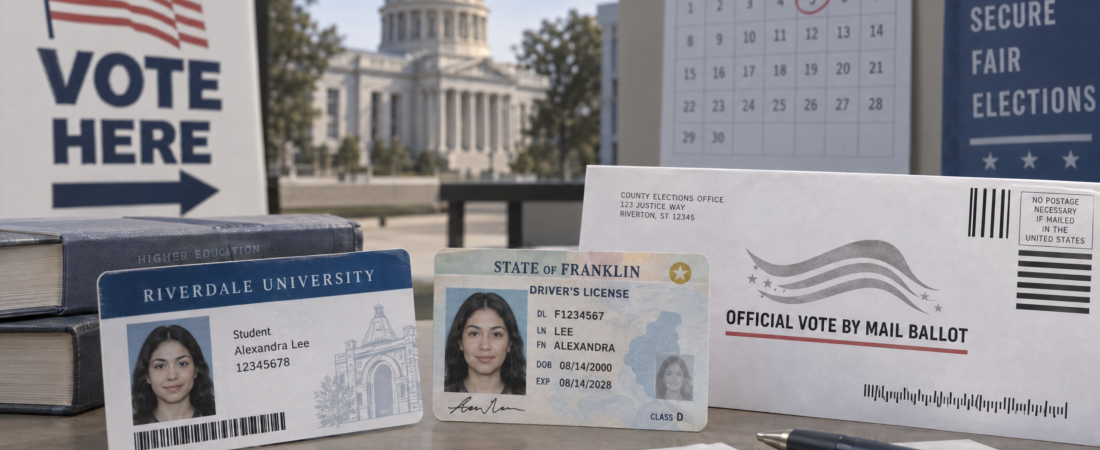
New Hampshire’s official rules now list a driver’s license, a state or out-of-state non-driver ID, a voting-only ID issued by the state DMV, a U.S. armed-services ID, or a U.S. passport or passport card as expressly valid photo identification. An ID generally remains usable for voting for five years after expiration; voters 65 and older may use an acceptable photo ID without regard to expiration. People without a listed document can ask election officials to verify identity through personal knowledge, but the Supreme Court’s stay means a student ID cannot be used as the basis officials were ordered to recognize. Official Election Day Voting guidance
The potentially affected group is younger voters, including high-school and college students who live away from home, lack a driver’s license or passport, or have difficulty reaching the DMV. Out-of-state students may also need separate proof of domicile, age and citizenship. Durham reporting describes students arranging rides and alternate documents. Seacoast Online reporting
There is no authoritative statewide count of voters who would otherwise rely on a student ID. It would be inaccurate to equate total college enrollment with ballots at risk. Student-voting advocates describe student-ID restrictions as a barrier, but the measurable effect in New Hampshire will depend on how many voters lack another acceptable document and whether local officials can verify them through other means. The New York Times Inside Higher Ed
Why the timing matters nationally
The case fits a wider pattern of courts being asked to change election procedures shortly before voting. Purcell is not a categorical ban on late action; it tells courts to weigh confusion for voters, poll workers and administrators. The question here is whether limiting the secretary’s interpretation would stabilize the election or create new instructions.
The ruling is politically consequential, but it does not show that the restriction will determine turnout or the Senate race. Republicans, including the RNC, supported the state; voting-rights plaintiffs say the restriction burdens young voters and may conflict with the 26th Amendment. Those claims remain unresolved. Associated Press New Hampshire Bulletin
For voters, the message is simple: bring a listed government-issued ID if possible, and consult election officials about alternate verification. The First Circuit—and potentially the Supreme Court—must still decide whether to uphold HB 323 and the secretary’s guidance. Until then, the Oct. 22 order governs the midterms, while the law’s effect on youth participation remains uncertain.
Sources
- Supreme Court of the United States, Scanlan v. Coalition for Open Democracy, No. 26A512, order and dissent, Oct. 22, 2026.
- New Hampshire Secretary of State, “Election Day Voting,” updated after the Oct. 22 stay.
- U.S. District Court for the District of New Hampshire, partial preliminary-injunction order, Oct. 2, 2026.
- SCOTUSblog, “Supreme Court allows New Hampshire to restrict use of student IDs in voting,” Oct. 22, 2026.
- Associated Press, “Supreme Court allows New Hampshire to fully ban student IDs for voting in midterms,” Oct. 22, 2026.
- The New York Times, “Supreme Court Allows Blanket Ban on Student IDs at Polls in New Hampshire,” Oct. 22, 2026.
- New Hampshire Bulletin, “US Supreme Court ruling restores NH ban on use of student IDs at polls,” Oct. 22, 2026.
- Inside Higher Ed, “N.H. Voters May Not Use Student IDs at Midterm Polls,” Oct. 26, 2026.
- Seacoast Online, “UNH students scramble to vote after student ID ban,” Oct. 28, 2026.
- New Hampshire Department of Justice, “Attorney General Formella and Secretary of State Scanlan provide voters update on use of student IDs,” Oct. 23, 2026.
Reporting note: This article reflects information available Oct. 28, 2026. The underlying appeal remained unresolved on that date, and no authoritative statewide estimate of affected voters was available.