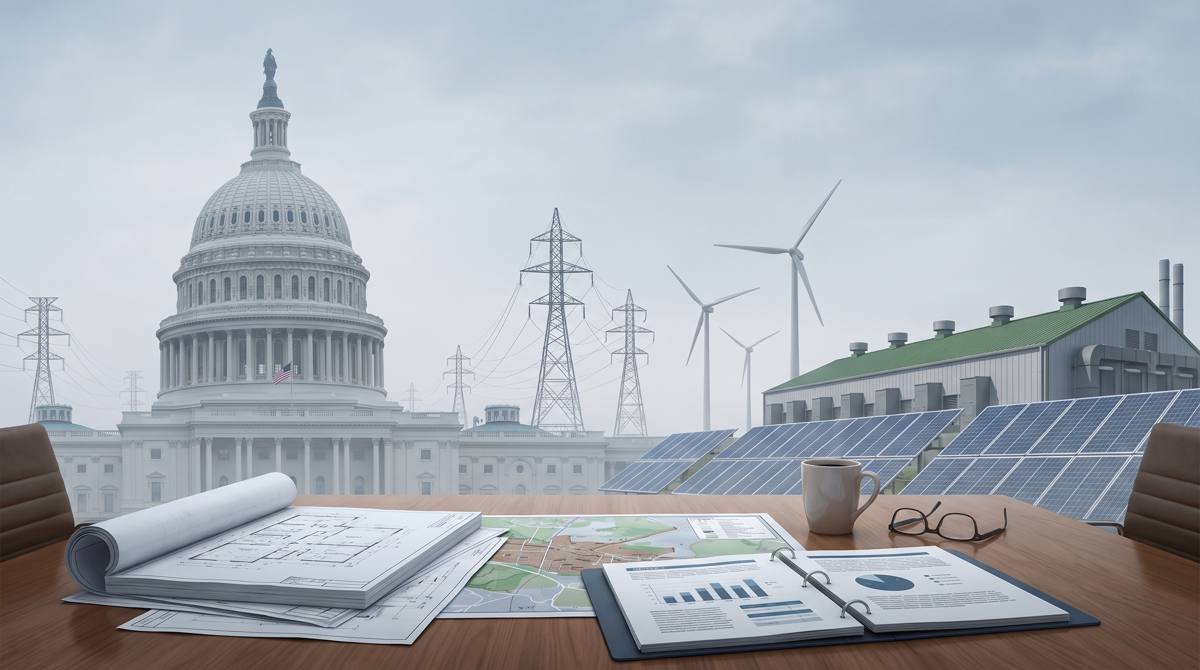
The Senate has advanced a bipartisan energy permitting bill that supporters say could speed construction of power lines, power plants, mines and other infrastructure while limiting the risk that data-center expansion raises household electricity bills. The vote is the most consequential recent step for the Bipartisan American Affordability and Jobs Act of 2026, or BAAJA, and gives the measure a path into a larger debate over energy costs, industrial investment and environmental review.
The bill is not law. The Senate action opened the way for debate; it did not enact the package, and the House has not passed it. Supporters frame the measure as a practical response to rising electricity demand and lengthy project approvals. Opponents say the speed provisions could weaken environmental safeguards and tribal rights. Those unresolved tradeoffs make the bill a significant economic-policy story, but not a settled policy change.
Facts: What the Senate did and what the bill would change
On Nov. 9, the Senate advanced BAAJA by a 73-25 vote, according to the Senate Environment and Public Works Committee. The procedural vote followed the release of a substitute amendment on Nov. 7. The amendment’s sponsors said it made clarifying and technical changes after discussions with lawmakers, tribal representatives, environmental organizations and industry groups. The Senate Energy and Natural Resources Committee’s announcement highlighted stronger tribal consultation and provisions intended to make large data centers pay for the energy and grid upgrades they require.
The underlying bill, S. 5653, would revise parts of the National Environmental Policy Act, Clean Water Act, Endangered Species Act, National Historic Preservation Act and Federal Power Act. The Congress.gov summary says the package would narrow some environmental reviews, establish deadlines after reviews are complete, alter certain water-quality and species-consultation requirements, and accelerate several energy projects. It would also expand the Federal Energy Regulatory Commission’s authority over some interstate transmission projects.
The Senate vote is a change in procedural status, not final passage. Congress.gov still lists S. 5653 as “Introduced,” with the bill referred to the Senate Energy and Natural Resources Committee. That status page has not yet been updated to reflect the floor advance, so the official record should be read alongside the Senate committee announcement and the vote itself. No final House text or presidential action exists as of Nov. 11.
Facts: Why transmission and data centers are central
The policy case rests partly on the difficulty of building infrastructure quickly enough to meet demand. The Congressional Research Service says BAAJA would broaden the circumstances in which FERC could use backstop siting authority for certain interstate transmission lines. Under the proposal, some large lines could enter federal review earlier and could be considered at the same time as a state application. CRS’s analysis also describes proposed cost-allocation rules requiring transmission customers to receive benefits roughly commensurate with the costs assigned to them.
The data-center provision addresses a newer political concern. Large computing facilities can require substantial electricity and new transmission or generation capacity. The bill’s ratepayer provisions are intended to prevent those infrastructure costs from being shifted broadly onto households and small businesses. That is the direct affordability link: the measure would not immediately lower a family’s bill, but it could change who pays for new grid investment and how quickly added supply can be built.
Senate supporters are also making broader economic claims. Committee Chairman Shelley Moore Capito cited estimates that permitting delays cost manufacturers $12.1 billion annually and said a White House Council of Economic Advisers analysis projected $82 billion to $164 billion in additional yearly economic output under the reforms. Those are estimates, not observed savings. They depend on how agencies, courts, states and project developers implement the final law, if Congress passes one.
Analysis: A bipartisan deal with a narrow path
The vote shows that permitting reform can attract support from both parties when it is tied to transmission, manufacturing, jobs and household costs. It also exposes why the issue is difficult. Faster reviews may reduce delay and financing uncertainty, but environmental review is designed to identify harms before construction. Changing the scope or timing of that review can shift costs to communities, ecosystems, taxpayers or future utility customers.
The internal Democratic split is visible in the official record and independent reporting. Reuters reported that Senators Martin Heinrich and Sheldon Whitehouse backed the bill after negotiated changes, while other Democrats remained concerned about natural-gas and liquefied-natural-gas projects, public lands, and tribal sovereignty. Senator Edward Markey’s statement said he opposed advancing the measure without more committee review and time to resolve questions about clean-water protections, tribal rights and litigation limits.
That disagreement matters politically because the bill’s sponsors are trying to secure a durable compromise before the next Congress, even after Democrats’ midterm gains. A permitting law that passes only through one party could be vulnerable to future reversal. A bipartisan measure could provide developers more certainty, but only if the coalition survives negotiations over environmental review, project categories and the balance between federal, state and tribal authority.
Analysis: What the proposal could mean for households and businesses
The practical effects would arrive unevenly. A faster permit does not guarantee that a project will be built, that new generation will be cheap, or that a utility will pass savings directly to customers. Developers still face financing costs, equipment prices, state and local approvals and grid-connection limits.
The ratepayer language is therefore important but limited. If large data centers pay more of the cost of new substations, transmission or generation, those charges would not automatically reduce existing bills. They could, however, reduce the chance that ordinary customers subsidize new high-demand facilities through regional utility rates. The Congressional Research Service’s description of benefit-based transmission cost allocation points in the same direction: customers receiving little or no benefit would face limits on involuntary cost assignments. How regulators define “benefit” would matter in practice.
Businesses are watching the certainty provisions as closely as the speed provisions. A permit protected from reversal may give investors more confidence, but it also raises a public-interest question: how much flexibility should agencies retain if a project’s effects become clearer after approval? The answer would depend on statutory language, court interpretation and agency rules that have not yet been written.
What to watch next
The next meaningful indicators are Senate debate, any additional amendments, and whether the House leadership endorses the package or seeks a different permitting framework. Watch also for agency and tribal-group responses, because implementation details would determine whether data centers actually bear more grid costs and whether transmission projects move faster without eliminating meaningful public participation.
As of November 11, 2026, BAAJA is an advanced but unfinished Senate proposal. Its potential political effect is immediate: electricity affordability and permitting are now linked in a bipartisan legislative test. Its promised economic benefits remain projections, and its environmental and procedural disputes remain unresolved.
Sources
- U.S. Senate Environment and Public Works Committee: Senate Advances BAAJA
- Congress.gov: S. 5653, Bipartisan American Affordability and Jobs Act of 2026
- Congressional Research Service: BAAJA and FERC backstop siting authority
- Senate Energy and Natural Resources Committee: Substitute amendment
- Reuters: Senators rally support for permitting bill before vote
- Senator Edward Markey: Statement on permitting reform deal