
Twelve Republican-led states have formally begun appealing a federal judge’s September ruling that blocked the U.S. Postal Service from enforcing its new mail-ballot rule, restarting a legal fight that will shape how millions of Americans receive ballots in the 2028 presidential election.
The states filed a notice of appeal with the U.S. Court of Appeals for the D.C. Circuit on Thursday, Nov. 12, according to NPR and States Newsroom. The injunction remains in effect while the appeal proceeds. As of Nov. 14, 2026, no appeals court ruling on the rule’s legality has been issued, and it is not publicly clear whether the Justice Department will file its own appeal.
What the twelve states filed
The notice was filed by the attorneys general of Alabama, Florida, Indiana, Kansas, Louisiana, Missouri, Montana, Nebraska, Oklahoma, South Carolina, South Dakota and Texas, NPR reported. The states had previously intervened in the litigation to defend the rule.
The appeal targets a September preliminary injunction by U.S. District Judge Carl J. Nichols of the District of Columbia, a Trump appointee, in a consolidated challenge brought by Democratic campaign committees, congressional leaders and groups including Common Cause.
Facts: The filing is a notice of appeal, not a ruling on the merits. It preserves the states’ argument that the Postal Service had authority to issue the rule. The injunction is preliminary and stays in force unless a higher court pauses it.
Two states may not stay in the case long. Democratic candidates are set to take over the attorney general’s offices in Texas and Kansas in January, leaving it unclear whether those states will keep pressing the appeal, NPR reported. The Justice Department declined to comment, and it was not clear as of Friday whether the administration would file a separate appeal.
What the Postal Service rule would require
The rule, “Ballot Mail for Federal Elections,” implements Executive Order 14399, signed March 31, 2026. The Postal Service published the final rule on Aug. 26, effective Aug. 21, adding a section to its Domestic Mail Manual.
A Congressional Research Service analysis describes three main parts:
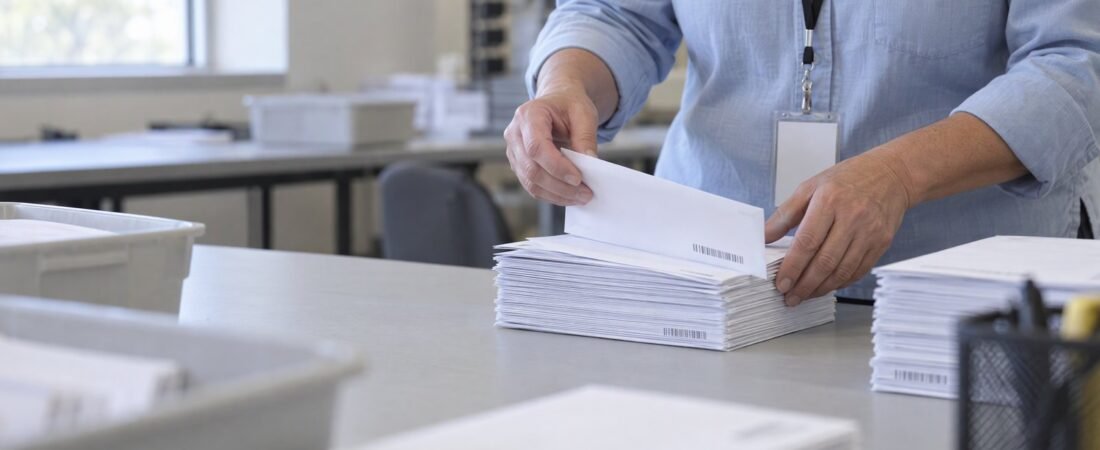
- Design standards. Outbound and return federal ballot envelopes would need the official Election Mail logo, a unique Intelligent Mail barcode and ballot mail service type identifier, compatibility with automated processing, and prior Postal Service design review.
- Participation lists. A state using mail ballots would submit voter names, mailing addresses and barcodes through a new Federal Ballot Mail Portal, creating state-specific mail-in and absentee participation lists.
- Verification and refusal. Before accepting a mailing, the Postal Service would check envelope design and whether recipients appear on the state’s list. Noncompliant mailings, or those addressed to voters not on the list, would be returned to the election office.
The scope is narrower than a blanket federal takeover. Primary elections, elections conducted entirely at the state and local level, and military and overseas ballots covered by federal law fall outside the rule, the CRS found. The Postal Service has said states “retain full control” over who is eligible to vote by mail. The CRS also noted that neither the executive order nor the rule let an individual voter appeal exclusion from a participation list, so a voter might learn of a problem only when a ballot does not arrive.
Why a federal judge blocked the rule
Nichols found the Postal Service likely lacked statutory authority. He wrote that key portions of the rule “exceed any conception of the outer bounds” of the agency’s power, according to Elias Law Group, which represents the Democratic plaintiffs.
The court concluded that nothing in the Postal Reorganization Act lets the agency impose election procedures on state officials, build a voter data system, or refuse to transmit lawful mail, Common Cause said. Nichols also noted the government pointed to no evidence that fraud would occur if the rule were enjoined.
His order went further than an earlier ruling in Massachusetts, where U.S. District Judge Indira Talwani barred the Postal Service from rejecting ballots for noncompliance but allowed other parts of the rule to proceed. Nichols blocked the rule entirely.
Where the Supreme Court left the fight
The rule never took effect for the 2026 midterms. In mid-September, the Supreme Court declined to revive it before the Nov. 3 election, leaving Talwani’s injunction in place for this cycle. Justices Samuel Alito and Clarence Thomas dissented.
Justice Brett Kavanaugh, who agreed with the majority, wrote that officials lacked time to “reasonably implement the rule” before the midterms, but added that “there is at least a fair prospect that the final rule falls within the Postal Service’s statutory authority.” Because Nichols’ injunction covers all federal elections, the appeal is the first step toward deciding whether the rule can apply in 2028.
What is at stake
At least 33.9 million mail ballots were cast in the November general election, according to the University of Florida Election Lab, as reported by States Newsroom. Eight states — California, Colorado, Hawaii, Nevada, Oregon, Utah, Vermont and Washington — authorize all-mail elections.
Supporters say the rule adds safeguards. Missouri Secretary of State Denny Hoskins wrote in an August court declaration that it “would help bolster the security of mail voting” and reduce fraud risk. The Postal Service says the rule is constitutional and does not make it an election administrator. Opponents say it would override state law and give Washington a gatekeeping role over ballot delivery.
At a USPS Board of Governors meeting on Nov. 10, postal unions and Democratic secretaries of state urged the board to rescind the rule permanently. Postmaster General David Steiner told the board that “in this election, the USPS did exactly what we can always do. We put our heads down, and we got the job done.” The American Postal Workers Union argues the board has authority to withdraw the rule rather than leave it in place while courts weigh it.
Analysis: why the fight outlasts the midterms
Analysis: The appeal is less about the 2026 results than about the rules that will govern 2028. With Democrats set to control Congress in January, both sides are positioning for a longer legal and political campaign over election administration.
Three factors will shape what happens next. The D.C. Circuit’s review will likely turn on statutory authority — whether Congress gave the Postal Service power over ballot delivery — rather than competing claims about fraud. The coalition defending the rule may shrink, since Texas and Kansas are set to have Democratic attorneys general. And Congress and the Postal Service’s board have leverage courts do not: lawmakers can hold oversight hearings, and the board can withdraw the rule without waiting for a verdict.
Nothing in the record so far shows the rule changed the outcome of any 2026 race; it was blocked before taking effect. The risks the CRS identified are logistical — new envelope requirements, a new data portal and returned mailings — and no compliance timeline for 2028 has been set. Preliminary injunctions are also reviewed for abuse of discretion, so the case could still return to the Supreme Court. What to watch: whether the Justice Department appeals or either side seeks a stay, the D.C. Circuit’s briefing schedule, and whether the board rescinds the rule on its own.
Sources
- NPR: GOP state officials appeal block on 2028 mail voting limits
- States Newsroom: Democratic state officials, USPS battle over Trump mail ballot rule
- Congressional Research Service: USPS Ballot Mail Rule (IF13297)
- Federal Register: Ballot Mail for Federal Elections final rule
- Common Cause: Judge freezes USPS mail ballot rule
- Elias Law Group: Court blocks mail ballot rule in its entirety
- Government Executive: USPS “got the job done” delivering ballots
- APWU: Pull the rule, protect vote-by-mail
Related coverage from The Brief Lens: DOJ drops California ballot case, California ballot ruling and what election officials face next, and Democrats take control of Congress.