
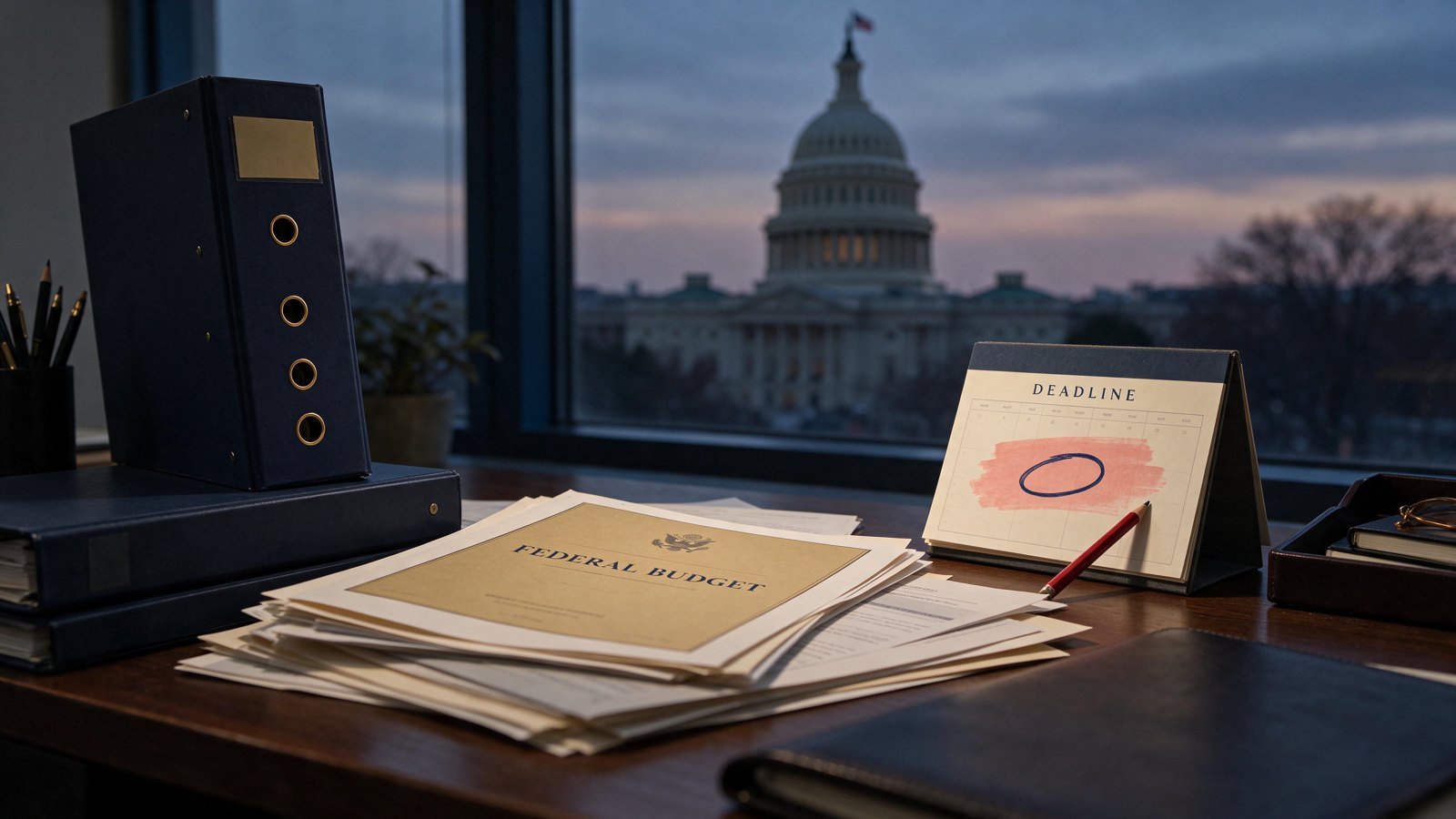
Congress has roughly three weeks to prevent another federal funding lapse after lawmakers return from the Thanksgiving break. The current continuing resolution expires on December 11, and negotiations are complicated by a proposed increase in Pentagon spending, disagreements over the administration’s war policy, and the limited time available in the lame-duck session.
The deadline is an economic-policy issue as well as a political one. A shutdown can interrupt federal services, delay payments and create uncertainty for contractors, workers, households and businesses even when essential functions continue. It also forces Congress to decide whether to pass short-term funding, complete some annual appropriations bills, or accept a broader confrontation.
As of November 23, 2026: Federal agencies are funded under a continuing resolution through December 11. No final agreement has been reached to replace it. A funding gap could begin December 12 if Congress does not enact regular appropriations or another continuing resolution.
Facts: What the current funding law provides
The Congress.gov record for H.R. 6500 shows that the Continuing Appropriations and Extensions Act, 2027 became Public Law 119-103 on September 2. Its continuing-appropriations division funds federal agencies through the earlier of December 11 or the enactment of the relevant regular appropriations law.
The measure was designed to prevent the immediate shutdown that otherwise would have occurred when fiscal year 2027 began on October 1 without all regular appropriations bills enacted. For most covered programs, it largely continues funding at fiscal year 2026 levels, with specified exceptions and additional flexibility for selected programs.
The Congressional Research Service summary says the law covers agencies funded through all 12 regular appropriations bills for a 72-day period from October 1 through December 11. The Congressional Budget Office estimated that the continuing-appropriations division represents about $1.701 trillion in annualized discretionary budget authority for fiscal year 2027. That is an annualized funding rate, not the amount Congress will spend during only the 72-day period.
CRS also says the law includes exceptions for programs such as the Special Supplemental Nutrition Program for Women, Infants, and Children, Small Business Administration loans, disaster relief, the Indian Health Service, the Justice Department and wildfire suppression. Those provisions do not remove the need for Congress to address the broader funding deadline.
Facts: Why negotiations are difficult
Reuters reported that lawmakers were divided over President Donald Trump’s request for $350 billion in additional Pentagon spending and over whether funding legislation should restrict the administration’s use of force in the Iran war.
Republicans were discussing a bipartisan package as well as the possibility of using budget reconciliation for some defense spending. Reuters reported that a Republican proposal for a $1.1 trillion defense appropriations bill included $69 billion of the president’s requested additional funding. The difference between those numbers is one measure of the unresolved dispute, not a final negotiating position.
Democrats face a separate choice. Some lawmakers want conditions or limits on funding connected to the war, while others warn that a shutdown would not end the conflict and could harm federal workers and families just before the holidays. Senate passage of a broad bipartisan funding package would generally require 60 votes, giving both parties leverage.
The lame-duck calendar adds pressure. Congress must decide whether to complete some of the 12 annual appropriations bills before the deadline and use a continuing resolution for the rest. Reuters quoted lawmakers saying that passing all 12 bills before December 11 was not realistic, while a partial package combined with a short-term CR remained possible.
Analysis: The funding cliff affects more than Washington
A continuing resolution preserves operations but limits agencies’ ability to start new projects, adjust programs or make long-term commitments. It can also complicate planning for grant recipients, contractors and state partners that depend on federal funds. The economic effect of a short shutdown varies by agency and duration, but uncertainty can spread before the deadline arrives.
A shutdown would not necessarily stop every federal activity. Programs with permanent or mandatory funding, activities needed to protect life and property, and work supported by other authorities can continue. But affected workers may be furloughed or required to work without immediate pay, and some services can slow even when they do not legally close.
The defense dispute makes the issue larger than a routine appropriations extension. If Congress adds a major Pentagon package, lawmakers must decide whether it is part of regular appropriations, a separate authorization or a reconciliation measure. Each route has different procedural rules and political consequences.
War-powers language creates another conflict between governing the federal budget and checking presidential authority. Republicans can argue that national-security funding should not be interrupted. Democrats can argue that Congress must use its appropriations power to shape military policy. Neither argument automatically resolves the shutdown risk created by the December deadline.
What to watch before December 11
The first indicator will be whether negotiators produce a bipartisan framework before the Senate and House return to full legislative work. The next will be the scope of any package: a clean continuing resolution, a mixed measure with selected appropriations bills, or a bill that includes defense and war-policy provisions.
A short-term agreement could postpone the immediate crisis but leave the same disputes for January, when Democrats are set to take control of both chambers. A longer agreement could give agencies more certainty but would require lawmakers to settle more issues while the current Congress is still responsible for funding the government.
As of November 23, the most supportable conclusion is that a shutdown is a risk, not an announced outcome. The deadline is established by enacted law, the funding negotiations are active, and the central disagreements are public. Whether Congress avoids a lapse will depend on the text of a funding measure and the votes it can attract, not on predictions made before lawmakers return.