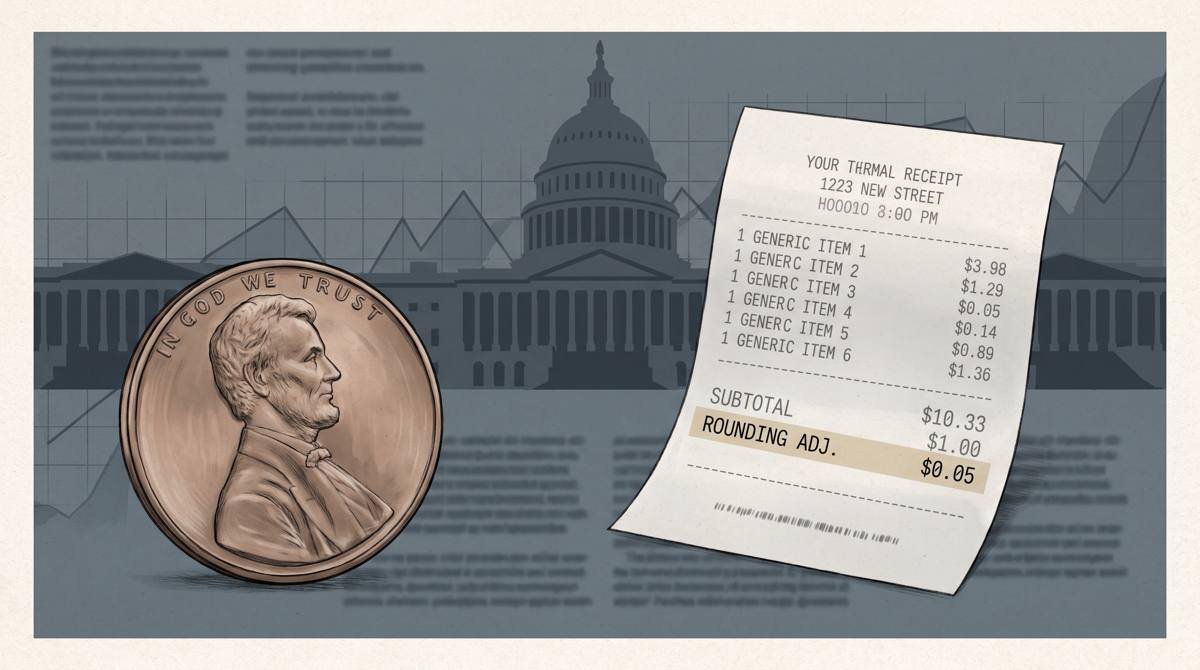
President Donald Trump signed the Common Cents Act into law on November 20, formally ending production of one-cent coins for general circulation and creating a nationwide framework for rounding cash transactions to the nearest five cents. The law does not cancel the value of pennies already in circulation. Instead, it begins a gradual change in how cash purchases are settled when exact change is unavailable.
The policy is a small-dollar change with wider implications for retailers, cash-paying consumers, point-of-sale systems and state tax administration. The law also gives the Federal Reserve and Treasury reporting duties intended to identify problems as the existing penny supply declines. As of November 21, 2026, the measure is enacted law, but the transition will continue while old pennies circulate.
Facts: What the new law does
The White House says the law directs Treasury to stop producing pennies except for collector needs. The Congressional Research Service summary on Congress.gov says existing pennies remain legal tender for debts, taxes and other payments. In other words, the law ends new circulation production; it does not require the public or businesses to destroy, exchange or refuse pennies.
Congress.gov records that the House passed the bill by voice vote on September 14, the Senate passed it without amendment by unanimous consent on September 28, and the president signed it on November 20. The measure is therefore no longer a proposal or pending rule. It is listed as “Became Law” in the legislative record. The White House signing statement also says the act allows Treasury to use cost-saving materials for the nickel and establishes procedures for discontinuing other circulating coins in the future.
For cash transactions, the law permits rounding when exact change cannot be provided. A total ending in 1, 2, 6 or 7 cents may be rounded down to the nearest five-cent amount. A total ending in 3, 4, 8 or 9 cents may be rounded up. A one- or two-cent transaction may be rounded up to five cents. The statute defines the covered amount as the total, including taxes, or the change due after a cash payment.
The rule applies to cash payments and cash transfers. It does not apply to credit cards, debit cards, checks, gift cards, money orders, electronic fund transfers or similar non-cash methods. The law also says rounding is not mandatory in every transaction. Employers that choose to round cash wage payments must round in the employee’s favor, although they may pay an exact amount instead.
The enacted bill text says the Federal Reserve Board must submit a strategic plan within 90 days. The plan must address penny orders and deposits at commercial coin terminals, possible disruptions in coin distribution and the effect on low-income, older, unbanked, underbanked and debanked people. Treasury must assess those effects and make recommendations to Congress as part of that process.
Facts: Why the penny is being phased out
Treasury’s penny-production FAQ says the total cost of producing a penny rose from 1.3 cents to 3.69 cents over the past decade. Treasury says the U.S. Mint projects immediate annual savings of $56 million in reduced material costs if production stops. The agency also says roughly 114 billion pennies remain in existence and that the Federal Reserve will recirculate them for as long as possible.
Those figures explain the fiscal case for stopping new production, but they do not mean the transition happens overnight. Pennies will continue to be found, deposited and used. Treasury says businesses should continue accepting them while they remain in circulation. The Associated Press reported that the Mint produced 3.2 billion pennies in 2024 and that retailers had pressed Congress for clearer rules as supplies became harder to manage.
Analysis: The immediate issue is implementation, not the value of the coin
The law’s practical effect will depend on retail systems and state-level tax rules. Treasury recommends that businesses calculate all taxes and fees first, then apply rounding only to the final cash amount. It says electronic transactions should continue to be processed to the exact cent. The department also acknowledges that states and localities may need to update their own sales-tax laws and guidance.
That distinction matters because a rounded cash total is not necessarily the same thing as a rounded taxable price. If a retailer rounds before calculating tax, the result could differ from the statute’s intended sequence and from state requirements. Treasury’s guidance says states remain responsible for deciding how their tax laws interact with the new federal framework.
Retailers are likely to benefit from a clearer nationwide baseline. Before enactment, businesses faced uncertainty about what to do when they lacked pennies and could face disputes over whether a rounding adjustment was lawful. The National Association of Convenience Stores, an industry group, said the law gives retailers certainty for cash transactions. That is an interested perspective, not an independent estimate of consumer effects, but it identifies a real operational question: registers, receipts and employee instructions must all apply the same rule.
The consumer effect should be small for an individual transaction if totals are rounded symmetrically. Treasury says cash totals should be rounded down about as often as they are rounded up, producing no overall price effect in theory. That is a design expectation, not a guarantee for every shopper. The distribution of prices, retailer practices, refund policies and local implementation could determine who experiences more upward or downward adjustments.
Cash users may face the greatest transition costs. People who rarely use cards or bank accounts may encounter more frequent rounding, while the bill specifically requires federal agencies to study effects on low-income and underbanked communities. The Federal Reserve’s reports will be important because they can show whether penny shortages create localized problems at banks, coin terminals or small retailers.
Analysis: A narrow savings measure with a broader political message
The law turns a long-running cost argument into a completed policy choice. Supporters can point to the Mint’s production-cost figures and projected savings. Critics can ask whether $56 million in immediate material savings is large relative to the administrative costs of changing registers, receipts, tax practices and coin distribution. The statute’s required reports reflect that the transition has consequences beyond the Mint’s budget.
The measure also illustrates how a symbolic object can become a business-regulation issue. Ending new pennies is easy to describe. Deciding how to calculate taxes, handle refunds, accept remaining coins and protect cash users is harder. The next phase will be judged less by the signing ceremony than by whether consumers see consistent receipts and whether businesses can comply without shifting hidden costs onto cash customers.
As of November 21, 2026, the Common Cents Act is law. New pennies for general circulation are ending, existing pennies remain legal tender, and cash rounding is permitted under federal rules. The scale of any consumer or distribution effects remains uncertain until Treasury and Federal Reserve implementation reports arrive.
Sources
- White House: H.R. 10167 – Common Cents Act
- Congress.gov: H.R. 10167 bill record and legislative actions
- Congress.gov: Enacted text of H.R. 10167
- U.S. Department of the Treasury: Penny Production Cessation FAQs
- Associated Press: Congress votes to end production of the penny
- National Association of Convenience Stores: Common Cents Act Signed Into Law