Trump’s Election-Integrity Lawsuits Put Midterm Certification in Focus
As of Oct. 28, 2026, the administration’s lawsuits and planned monitoring deployments have not changed the Nov. 3 voting rules—but they have created new legal and public-confidence risks around how results are counted and certified.
Meta description: Trump’s election-integrity lawsuits target voter rolls, an Alaska Senate ballot and observers. Here is what courts and states have said.
Primary keyword: election-integrity lawsuits
Secondary keywords: 2026 midterm election, DOJ election observers, ballot certification
President Donald Trump said Tuesday that he would accept the November 3 midterm results only if they were “honest.” The comment came as his Justice Department pressed states over alleged noncitizen voting, sued California and Alaska, and prepared a large election-monitoring operation.
The confirmed facts are narrower than the political claims surrounding them. Washington received a federal list of more than 400 people the DOJ says appear to be noncitizens who registered and voted. California is fighting a lawsuit involving roughly 20,000 people the government calls “likely” noncitizens. Alaska is defending its certification process against a lawsuit involving two candidates with similar names. None of those allegations, by itself, establishes widespread illegal voting or determines the result.
What the Washington case actually alleges
On Oct. 26, the U.S. attorneys for Washington asked state officials to segregate ballots cast by more than 400 people identified through federal data. The DOJ says many are lawful permanent residents, who cannot vote in federal elections, and says some voted in multiple elections. The agency has asked the state to confirm citizenship before counting affected ballots, according to its announcement and NBC News’ account.
Washington Secretary of State Steve Hobbs said his office was reviewing the request but would follow due process. His office says the federal system can flag U.S. citizens, notes that at least one record dates to 1994, and says federal law limits removals within 90 days of a federal election. The state’s response does not concede the DOJ’s classifications. The immediate question is whether officials can verify each record lawfully and quickly enough to affect counting.
California shows the court’s short-term limit
The DOJ sued California on Oct. 15, alleging that more than 20,000 people likely to be noncitizens were registered and sent mail ballots. Its complaint asks a court to require California to set those ballots aside while citizenship is checked. The department says it used voter-registration and federal immigration data; the complaint announcement describes the number as a preliminary identification, not a final adjudication.
California officials say the list contains major errors. Los Angeles County’s preliminary review of 200 names found that more than half had inactive or canceled registrations, 38.9% listed a U.S. birthplace and 71.2% showed no voting history, according to the state attorney general’s statement. The secretary of state says the federal government gave officials 48 hours to act without disclosing its methodology (California Secretary of State).
On Oct. 26, the Ninth Circuit dismissed the administration’s emergency request because it had gone directly to the appeals court before obtaining a trial-court order, California reported. The request has not produced an order delaying the state’s count.
Alaska is the clearest certification test
The Alaska lawsuit seeks to stop certification if Republican Sen. Dan S. Sullivan loses and a court later determines that votes for Daniel J. Sullivan Jr. would have changed the ranked-choice result. The DOJ says similar names could confuse voters. The ballot distinguishes the candidates by party and incumbent status, and Alaska’s Supreme Court allowed Daniel J. Sullivan Jr. to remain on the ballot, according to Reuters and NBC News.
Alaska has moved to dismiss. Election-law scholar Nicholas Stephanopoulos told the Harvard Gazette that the DOJ’s reliance on the National Voter Registration Act is weak because the dispute concerns ballot design and certification, not voter registration. Until a judge acts, the case remains capable of generating uncertainty, but it has not legally prevented Alaska from counting or certifying results.
What the observer deployment can—and cannot—do
The DOJ says it plans about 1,000 staff members in all 50 states on Election Day, focusing on population, past voting-rights concerns and competitive jurisdictions. PBS reports that monitors will observe and report, will not monitor early voting, and are not supposed to interfere. The DOJ’s explanation says federal observers operate under the Voting Rights Act and court orders, while attorneys and staff can conduct broader monitoring.
That scale is unusual, but presence is not power to seize ballots or rewrite state procedures. Local officials remain responsible for administering elections. The Associated Press reports that officials are preparing for a surge of federal, party and nonprofit observers, while some worry that overlapping observers could create confusion.
Could the lawsuits delay certification or undermine confidence?
The short-term legal record points to different levels of risk. California’s emergency request was rejected without a merits ruling. Washington’s officials were still reviewing the federal list as of Oct. 28. Alaska presents the most direct certification challenge because the requested remedy explicitly conditions certification on a candidate’s victory and a hypothetical reassignment of votes.
The larger effect may be institutional. Trump’s “honest elections” condition, late DOJ requests and the observer scale give supporters a framework for treating disputes as proof of a tainted result. State officials’ categorical dismissals can also outrun the records. The defensible conclusion is limited: the litigation has increased uncertainty, but no court decision reported by Oct. 28 has delayed certification of the November 3 results. That could change with pending rulings, state verification and the margins in any close race.
Sources
- U.S. Department of Justice, Washington announcement — DOJ allegations and requested ballot segregation.
- Washington Secretary of State, statement on safe and secure elections — state response, timing and data-quality concerns.
- NBC News, Washington ballot request — independent reporting and Washington officials’ response.
- Al Jazeera, Trump’s “honest” election comment — quote and broader chronology.
- U.S. Department of Justice, California lawsuit — complaint allegations and requested remedy.
- California Attorney General, Ninth Circuit setback — court posture and California’s list review.
- California Secretary of State, response to DOJ letter — deadline and state objections.
- U.S. Department of Justice, federal observers and election monitoring — legal framework and observer roles.
- PBS NewsHour, 2026 DOJ monitoring plans — planned scale and state concerns.
- Associated Press, election observers — deployment scale and parallel party monitoring.
- Reuters, Alaska certification lawsuit — filing and legal-context reporting.
- NBC News, Alaska lawsuit — complaint terms, ballot distinctions and procedural background.
- Harvard Gazette, legal analysis of Alaska case — attributed expert assessment and Alaska’s motion to dismiss.
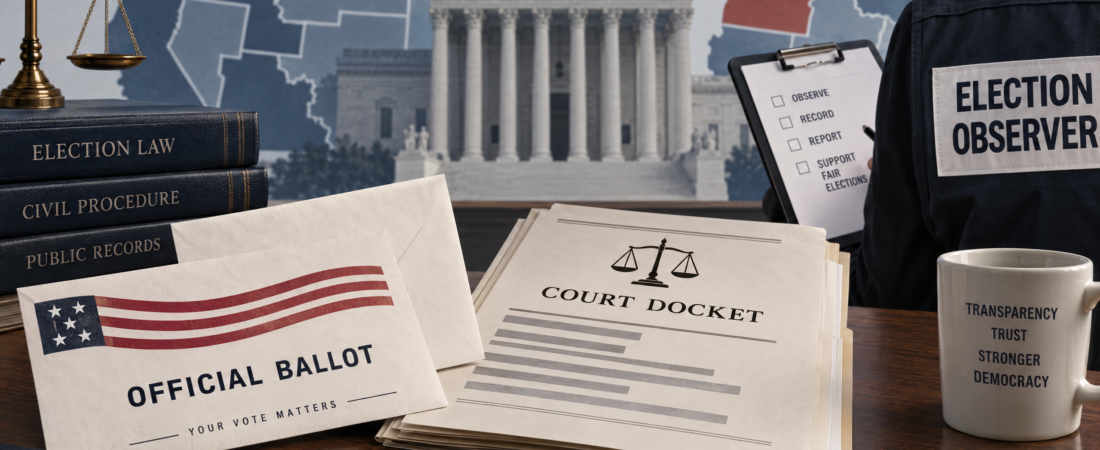
Editorial image prompt: Documentary-style editorial illustration of a U.S. ballot envelope, a courthouse docket, and a neutral election observer’s clipboard arranged on a public-records desk; muted navy, cream and red palette; no recognizable politician, no real polling-place incident, no fabricated document text; clearly labeled “Illustration,” realistic newsroom lighting, high detail.
Image alt text: Editorial illustration of a ballot envelope, courthouse docket and election observer clipboard representing 2026 election-integrity lawsuits.