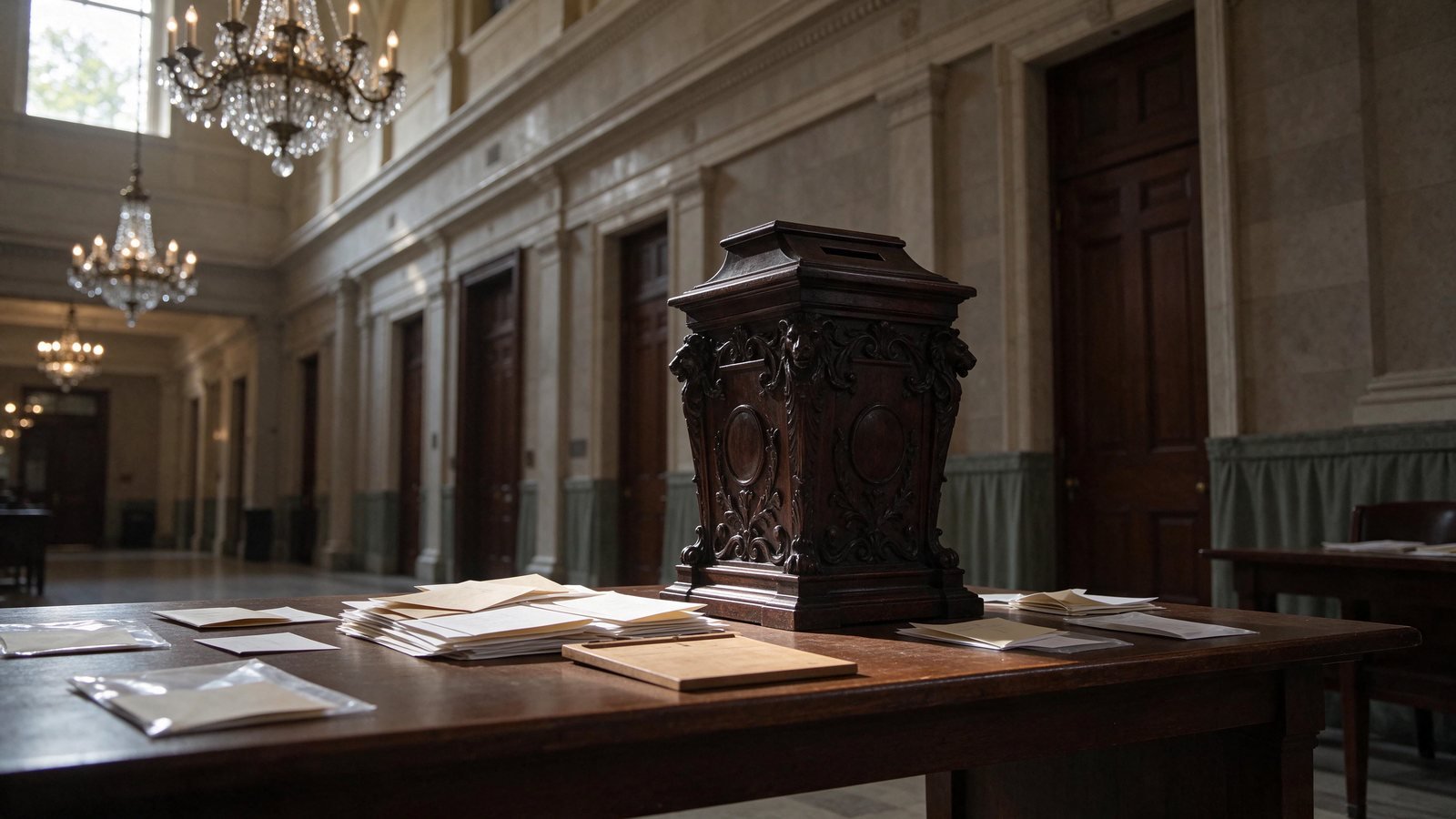
The Senate Rules and Administration Committee held a confirmation hearing Tuesday, Nov. 17, for Ashley Stow and Andrew Woodson, President Donald Trump’s two nominees to the Federal Election Commission. The hearing is a new step toward restoring the campaign-finance regulator’s ability to take formal enforcement and rulemaking action, but it did not itself restore the agency’s quorum. As of November 19, 2026, the committee has not announced a vote, and neither nominee has been confirmed.
The development is separate from the recent debate over donor disclosure. It concerns whether the FEC can again operate with the minimum number of commissioners needed for many of its core decisions before the next presidential election cycle intensifies.
Facts: Two nominees appeared before the Senate committee
The committee’s official hearing page lists Stow, of Texas, and Woodson, of Virginia, as nominees for FEC membership. The Senate Rules Committee hearing notice identifies the hearing location as Senate Room 301 and describes the two nominations. The hearing was held Nov. 17, according to the committee’s hearing listing and contemporaneous reporting.
The nominations themselves were sent to the Senate on Feb. 11. The official Congress.gov record for Ashley Stow says she was nominated for a term expiring April 30, 2029, in the seat previously held by Republican James E. Trainor III. The Congress.gov record for Andrew Woodson lists a term expiring April 30, 2031, in the seat previously held by Republican Allen Dickerson.
Both nominees are Republican selections. That matters because federal law structures the FEC as a six-member, bipartisan commission, with no more than three commissioners from one party. The agency’s policymaking decisions generally require at least four agreeing votes.
The Congressional Research Service reported in March that only two commissioners remained in office and that the vacancies had eliminated the FEC’s policymaking quorum. CRS said that, if both nominees were confirmed and no additional vacancy occurred, the commission would return to a four-member quorum.
The FEC has not been entirely inactive. Staff operations and public disclosure functions have continued. But, without the required commissioner votes, the agency cannot perform several central functions, including issuing rules, adopting advisory opinions, voting on enforcement matters, or imposing civil penalties. The CRS report distinguishes those limits from criminal enforcement, which remains a Justice Department responsibility.
Facts: The hearing produced commitments, not a confirmation
Sen. Alex Padilla, Democrat of California and the committee’s ranking member, questioned the nominees about independence, super PAC coordination and the enforcement backlog. In an official account of the hearing, Padilla said the FEC had lacked a quorum since 2025 and asked whether the nominees would handle complaints impartially.
Stow said that, if confirmed, she would carry out the job “with impartiality” and follow the law as enacted by Congress and interpreted by the courts. Woodson likewise said he would treat complaints consistently, including matters involving senior federal officials. Those were commitments made during testimony, not findings about any pending complaint.
Padilla also asked whether a federal officeholder may direct a super PAC. Both nominees declined to give a specific legal judgment, saying the question could come before them as commissioners. The exchange illustrates the political and legal sensitivity of an agency that could soon be asked to review high-profile campaign-finance complaints.
OpenSecrets, which reviewed the hearing, reported that the committee had not set a date for voting on the nominations. Its account of the hearing also reported that Stow described an enforcement docket of more than 300 matters. That figure came from the nominee’s testimony and should be treated as a reported backlog estimate, not as a newly adjudicated total.
Analysis: A four-member FEC would resume work, but not end the dispute
If the Senate confirms both nominees, the FEC would have four commissioners, enough to meet the statutory threshold for many actions. That would allow the agency to begin working through enforcement cases, consider requests for guidance and resume formal policymaking. It would not guarantee agreement on every matter: four members can still divide along party lines, and some decisions may require bipartisan support under the commission’s rules and governing law.
The timing also gives the nominations importance beyond the immediate administrative repair. Campaigns, political committees and outside groups are already preparing for the 2028 cycle. A functioning FEC could provide clearer guidance and make decisions on alleged violations instead of allowing matters to accumulate while the commission lacks a quorum.
The Senate’s schedule is the decisive uncertainty. The hearing advanced the nominees from written nominations to public testimony, but confirmation requires additional Senate action. A committee vote is not the same as confirmation by the full Senate, and confirmation is not the same as an immediate resolution of the agency’s case backlog.
There is also a political question about how the nominations will be handled after the 2026 midterm election. OpenSecrets reported that former Republican FEC commissioners urged Senate leaders to confirm the nominees before a new Democratic majority takes control, warning that the nominations could otherwise be delayed. That is an argument from former commissioners, not an announced Senate timetable.
The practical result on Nov. 19 is therefore limited but concrete: the Senate has held the hearing, the two nominees have made public statements about impartiality, and the FEC remains without a restored quorum. The next verifiable milestone is a committee action followed, if the nominations advance, by a vote of the full Senate.
As of November 19, 2026.
Sources
- U.S. Senate Rules and Administration Committee: Nomination Hearing
- Congress.gov: Ashley Stow nomination, PN806-10
- Congress.gov: Andrew Woodson nomination, PN806-11
- Congressional Research Service: Federal Election Commission—Membership and Policymaking Quorum
- Sen. Alex Padilla: FEC nominee hearing statement
- OpenSecrets: Senate considers FEC nominees
- C-SPAN: Senate Rules Committee considers FEC nominees