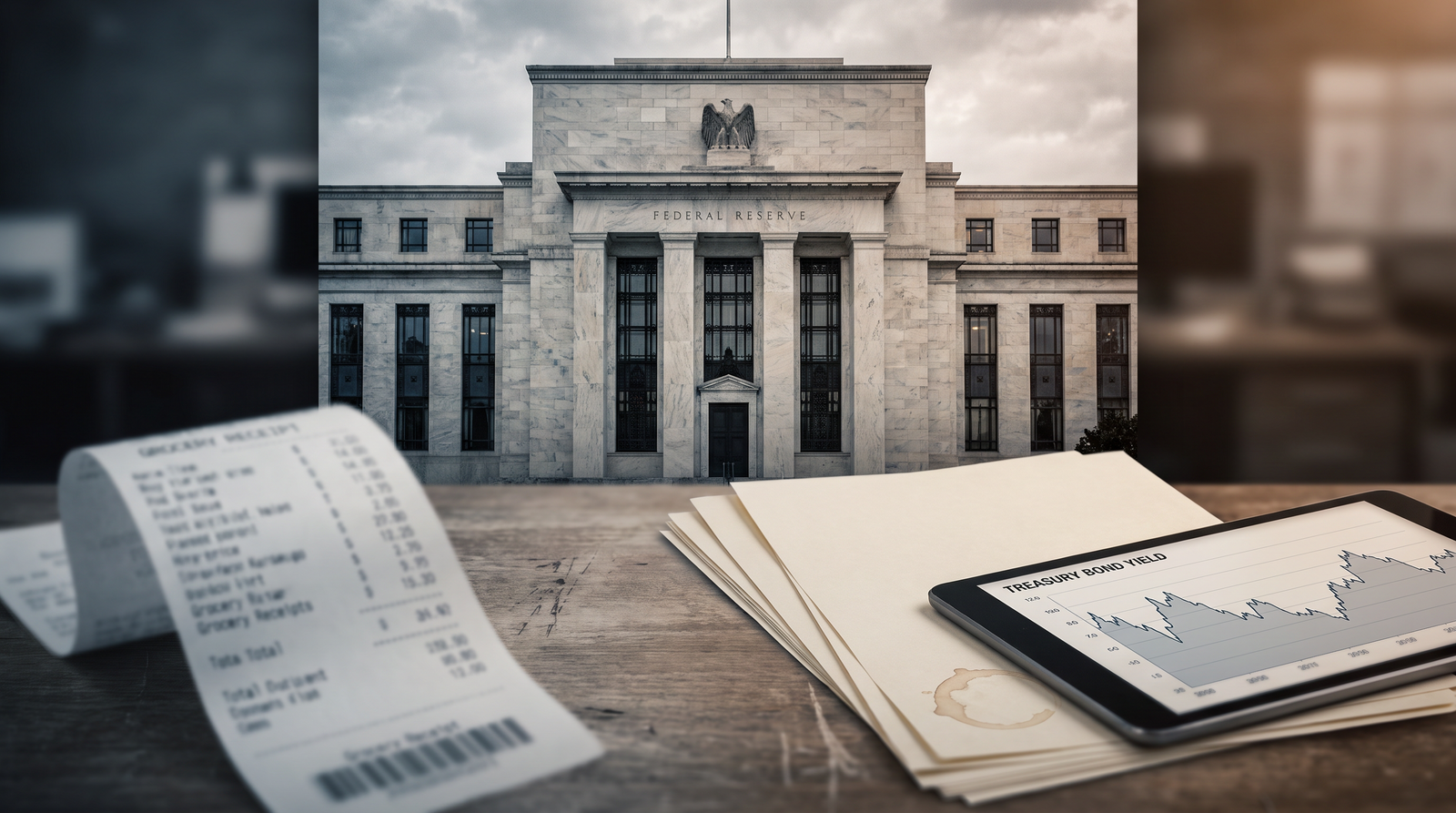
The Federal Reserve has put the U.S. economy in an uncomfortable political position: growth is strong enough to discourage an immediate rate cut, but prices are rising too quickly for policymakers to declare victory. At its October 28 meeting, the Federal Open Market Committee held the federal-funds target range at 3.75% to 4% by a 10–2 vote. Both dissenters favored a quarter-point increase. The Fed’s statement said economic activity was expanding at a “strong pace,” while “inflation remains elevated.”
That combination makes the Fed’s pause the most consequential economic-policy story heading into the November 3 midterm elections. It keeps borrowing costs high for households and businesses, leaves the administration with no quick monetary-policy relief to advertise, and gives both parties a fresh argument about who is responsible for the cost of living. It does not, however, prove that politics drove the decision.
Facts: What the Fed decided and why it matters
The October decision followed a quarter-point rate increase in September, which put the target range at its current level. The Fed’s latest statement upgraded its description of the economy from “solid” to “strong,” according to Reuters’ report on the meeting. The statement also said domestic spending was resilient, productivity growth was strong, capital investment was robust and job gains had kept pace with the workforce.
The vote was unusually divided. Fed Governor Lisa D. Cook and Cleveland Fed President Beth M. Hammack preferred to raise rates by another quarter point. That split signals that officials see meaningful risk from persistent inflation even as Chair Kevin Warsh argues that policy can bring prices down without unnecessarily weakening growth or employment.
The next policy decision is scheduled for December 8–9. Financial markets, as reported by Reuters, were pricing in about an 80% chance of a December hike after the October meeting, although expectations softened somewhat after Warsh’s news conference. That is a market forecast, not a Fed commitment. The committee said it would use the “accumulation of more information” to determine the appropriate stance.
The information pipeline is incomplete. The Bureau of Labor Statistics has scheduled the October employment report for November 6, after Election Day, and the October Consumer Price Index report for November 10. That means voters and policymakers are entering the election without the newest official readings on jobs and consumer prices.
Facts: Inflation is still above the Fed’s goal
The latest available CPI report, covering September, showed prices rose 0.6% in the month and 3.7% over the 12 months ending in September. The Bureau of Labor Statistics reported that gasoline prices rose 9.1% in September and were up 34.2% over the year. Energy overall increased 20.4% over 12 months. Core inflation, excluding food and energy, rose 2.6% over the year, while shelter increased 3.2%.
Those figures explain why a rate cut is not the Fed’s default response. The central bank’s formal inflation goal is 2%, and headline inflation is almost twice that pace. At the same time, the energy shock complicates the policy diagnosis: higher fuel prices can lift household costs and business expenses without necessarily showing that demand is overheating. The Fed must decide whether those increases will fade or spread into broader prices and wage-setting.
The labor market offers a counterweight. The September employment report showed payroll employment rose by just 29,000, unemployment held at 4.2%, and average hourly earnings increased 3% over 12 months. Earlier payroll figures were revised lower, with July and August employment combined revised down by 60,000. The data do not show a collapse, but they also do not describe an economy generating rapid job growth.
Analysis: Why the decision is politically potent
For voters, the immediate issue is not the technical target range. It is the price of groceries, fuel, rent and credit. A high policy rate generally raises the cost of mortgages, auto loans, credit-card balances and business financing. Holding rates steady avoids adding another immediate increase, but it also means households should not expect a near-term drop in borrowing costs.
That creates a political asymmetry. The administration can point to strong growth, investment and employment resilience. Opponents can point to inflation that remains well above target and to the fact that a 3.75%–4% policy rate still makes financing expensive. Neither side can credibly claim that the Fed has solved affordability before the election.
The timing has also sharpened scrutiny of the central bank. Reuters reported that Cook, whom President Donald Trump has targeted for removal, cast her first dissent in favor of a rate hike. Warsh said politics did not influence the decision. His denial matters because the Fed’s independence is itself part of the economic-policy dispute, but a statement from the chair cannot resolve every question about political pressure. The documented fact is the dissent and the president’s conflict with Cook; the motive behind Cook’s vote remains an interpretation, not an established finding.
Analysis: The bond market adds a fiscal warning
The rate decision is also connected to federal debt. Reuters reported that longer-term Treasury yields rose after the meeting as investors weighed persistent inflation, the prospect of further tightening and fiscal concerns. Short-term rates respond more directly to Fed decisions. Ten- and 30-year yields also reflect expectations for inflation, government borrowing and the compensation investors demand for holding long-duration debt.
The Congressional Budget Office’s February baseline projected a $1.9 trillion federal deficit in fiscal year 2026, equal to 5.8% of GDP, and debt held by the public at 101% of GDP. CBO’s outlook is an earlier baseline, not a new post-election forecast, and it incorporates policy assumptions that may change. Its figures nevertheless show why higher long-term yields matter politically: debt service can consume more budget space, making future tax and spending choices harder.
That is the central uncertainty after the midterms. If inflation stays high while growth remains firm, the Fed may keep rates elevated or raise them again. If hiring weakens sharply, officials may face pressure to support employment even before inflation reaches 2%. If long-term Treasury yields rise because of fiscal concerns, mortgage and business borrowing costs can stay high even without another Fed hike.
What to watch next
The next hard evidence arrives in stages: the October jobs report on November 6, the October CPI report on November 10 and the Fed’s December meeting on December 8–9. Until then, the October decision is best read as a pause under pressure, not a settled policy direction.
The political effect is clear even if the economic path is not. Voters are judging an economy that can look strong in aggregate while feeling expensive in daily life. The Fed’s choice to wait keeps that tension at the center of the national debate—and leaves the next move dependent on data that will arrive after Election Day.
Sources
- Federal Reserve, October 28, 2026 FOMC statement
- Reuters, “Fed leaves rates unchanged as it awaits ‘accumulation of information’”
- Reuters, “Fed highlights economic strength but muddies outlook for Treasuries”
- U.S. Bureau of Labor Statistics, Consumer Price Index, September 2026
- U.S. Bureau of Labor Statistics, Employment Situation, September 2026
- Congressional Budget Office, The Budget and Economic Outlook: 2026 to 2036