DOJ political enforcement and the 2026 midterm run-up
Primary keyword: DOJ political enforcement
Secondary keywords: Todd Blanche campaign activity; Justice Department election norms; Trump political opponents
Slug: doj-political-enforcement-2026-midterms
Meta description: DOJ political enforcement is under scrutiny as Todd Blanche campaigns for Trump allies while cases and election actions target opponents.
Dek: A documented timeline shows why the Justice Department’s late-October actions have raised questions about election-period norms, ethics safeguards and prosecutorial independence.
As the November 3 midterms approach, the issue is timing and appearance: Attorney General Todd Blanche has appeared at Trump-aligned political events while his department has pursued conspicuous cases, a search warrant and election litigation affecting Democratic figures and contests.
The record establishes the sequence. It does not, by itself, establish that any prosecution was brought for political reasons. Defendants remain presumed innocent, and courts—not campaign speeches—will test the allegations.
The late-October timeline
On April 28, a federal grand jury indicted former FBI Director James Comey on two alleged threat offenses tied to an Instagram image reading “86 47.” The Justice Department’s announcement says the indictment is an accusation. On October 26, a Washington judge unsealed additional charges, according to The New York Times. Trump’s long public attacks on Comey establish political context, not prosecutorial motive.
On October 12, Homeland Security Investigations agents searched Rep. Ilhan Omar’s Washington home under a DOJ-secured warrant. The New York Times reported that the inquiry concerns possible immigration-related false statements and that subpoenas went to relatives. A warrant and subpoena show investigative steps, not guilt. A congressional letter calls the search election interference, while the affidavit and full evidentiary basis are not public.
On October 22, DOJ announced an eight-count indictment against Virginia state Sen. L. Louise Lucas, alleging a marijuana-distribution enterprise, money laundering, bribery-related honest-services fraud and firearms offenses. The Eastern District of Virginia release says the investigation included May search warrants. Lucas has not been convicted; the allegations must be tested in court. The case drew scrutiny because Blanche announced it weeks before voting and Lucas is a prominent Democrat, but those facts alone do not resolve whether the evidence or timing was improper.
The department also sued on October 22 to stop Alaska from certifying a Senate result if Republican incumbent Dan Sullivan loses narrowly, arguing that a second candidate with the same surname could confuse voters. President Trump said, “I’m the one that said do it,” according to PBS NewsHour; Reuters reported Blanche’s defense that the suit was not designed to give Trump control of state elections. Alaska has asked for dismissal, and Alaska Beacon reported that the judge expedited briefing. The legal outcome remained unsettled on October 28.
Why Blanche’s campaigning changes the optics
Blanche has appeared at a North Carolina Senate rally, the Republican National Midterm Convention and other candidate events, according to PBS reporting. October DOJ guidance emphasized a Hatch Act exception for Senate-confirmed presidential appointees. The Office of Special Counsel says qualifying appointees may be exempt from some on-duty restrictions, but they still may not use official authority to affect an election. DOJ’s guidance says the department has historically applied stricter internal rules to avoid the appearance that politics drives law enforcement.
That is the difference between legality and institutional trust. A campaign appearance can be permitted under the Hatch Act while still making the public more skeptical when the same official announces cases involving a president’s prominent opponents. PBS quoted a former DOJ ethics official who said the revised standard lowers a long-standing department norm; DOJ said the memo clarified an existing statutory exception.
What the election-period norm actually is
DOJ’s so-called “60-day rule” is not a statute and is not an automatic bar on investigations. It is a norm against overt investigative or prosecutorial steps that could influence an election. The Justice Manual’s election-integrity chapter and the department’s 2024 election-year guidance describe heightened sensitivity, while recent USA Today reporting notes that prosecutors may proceed when delay risks evidence or public safety.
That leaves a judgment call, not a bright line. Prosecutors can argue that the actions respond to evidence or legal duties. Critics can argue that the department chose unusually visible steps close to voting while its leader was campaigning. Both propositions can be true without proving a hidden motive.
The unresolved test is independence
The practical safeguards are transparency, documented probable cause, judicial review and recusals where conflicts create a disqualifying appearance. The public record shows official denials and legal filings, but not every internal approval, warrant affidavit or recusal decision. Those gaps limit what can responsibly be concluded.
The fairest assessment as of October 28 is narrower than either side’s rhetoric: DOJ has taken unusually visible, election-adjacent actions while Blanche has embraced a more openly political public role. Whether that reflects evidence-based enforcement, selective enforcement or both is a question for courts, inspectors general, Congress and voters—not a fact established by campaign claims. Federal power must be seen, as well as shown, to operate without fear or favor.
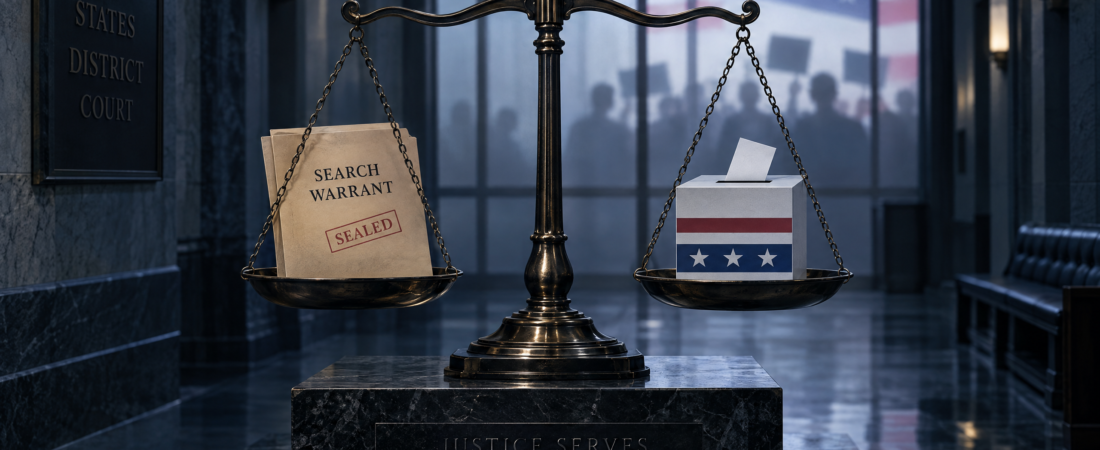
Editorial image prompt
Create a sober editorial illustration, not a photorealistic depiction of any real politician: a dark blue federal courthouse corridor with a balanced scale, one pan holding a sealed search-warrant folder and the other holding a ballot box, while a blurred campaign banner appears behind frosted glass. Use documentary textures, restrained navy, white and muted red, no readable names, no invented event, and a small label reading “Editorial illustration.”
Alt text: Editorial illustration of a federal courthouse scale balancing a search-warrant folder against a ballot box, with a blurred campaign banner behind glass.
Sources
- U.S. Department of Justice, Comey indictment announcement — official charging allegations and presumption of innocence.
- U.S. Attorney’s Office, Eastern District of Virginia, Lucas indictment — official indictment summary and search-warrant detail.
- U.S. Office of Special Counsel, Hatch Act FAQ — rules for Senate-confirmed presidential appointees.
- DOJ Justice Management Division, Political Activities — department guidance and stricter internal norm.
- DOJ Justice Manual, Protection of Government Integrity — election-related policy framework.
- DOJ 2024 election-year sensitivities memorandum — historical guidance.
- PBS NewsHour, Blanche political-activity memo — campaign appearances and ethics dispute.
- The New York Times, Omar investigation — search warrant, subpoenas and timing.
- Pramila Jayapal et al. congressional letter — attributed congressional objections and cited policy.
- PBS NewsHour, Alaska lawsuit — DOJ suit and Trump’s attributed statement.
- Reuters, Blanche on Alaska — administration defense and critics’ response.
- Alaska Beacon, dismissal effort — procedural status as of October 27.
- USA Today, late election cases — historical timing context and DOJ response.
- The New York Times, late-October DOJ actions — timeline and attributed criticism.
- The New York Times, U.S. attorneys — broader department context.