House GOP Leadership Contest Takes Shape Before the 2026 Midterms
Meta description: House GOP leadership contenders are positioning before Nov. 3 as Trump’s standing and the party’s narrow majority face growing uncertainty.
Slug: house-gop-leadership-contest-2026
Primary keyword: House GOP leadership contest
Secondary keywords: House Republican leadership; minority leader race; 2026 House elections
Dek: Jim Jordan and Steve Scalise are the most watched names in a post-election contest whose stakes depend on Republican losses — and whether the party still holds the gavel.
A quiet House GOP leadership contest is taking shape before voters decide its central question: will Republicans still be the majority party in January? Jim Jordan and House Majority Leader Steve Scalise are the leading names being discussed for the top conference post. Speaker Mike Johnson says he expects to keep leading even if Republicans lose the chamber, while Tom Emmer, the majority whip, is a possible alternative.
None of those possibilities is a formal nomination as of Oct. 28. Republicans are preparing for both a narrow survival and a potentially substantial defeat, with internal leadership elections scheduled for Nov. 10, one week after Election Day.
Why the contest is starting early
Politico reported Oct. 28 that Jordan is signaling a more unifying posture as Republican candidates in deep-red districts seek political cover. At a Republican rally in South Carolina, Jordan said Republicans were helping “anybody, everybody” and urged the party to stick together. Politico’s account of the shadow campaign described the shift as notable because Jordan built his national profile through confrontations with Republican leaders and the party’s right flank.
The backdrop is difficult for House Republicans. A Reuters/Ipsos poll reported Oct. 26 put President Donald Trump’s approval at 32%, with registered voters preferring Democrats over Republicans by 47% to 36% on the generic congressional ballot. That national measure does not determine House control, but it helps explain why members in districts Trump carried comfortably are campaigning defensively.
Reuters’ survey of competitive House races identified vulnerable Republican-held or Republican-targeted contests in New York, Colorado, Iowa, Ohio, Washington and Montana. Cook Political Report’s Oct. 23 ratings update rated 220 seats Solid, Likely or Lean Democratic, 198 Solid, Likely or Lean Republican, and 17 as Toss Ups. Those are forecasts, not results.
Jordan and Scalise offer different paths
Jordan, an Ohio Republican and House Judiciary Committee chairman, would offer conservatives a familiar fighter with strong ties to Trump’s political movement. His challenge is broader acceptability inside a conference that has struggled to turn ideological energy into dependable floor votes. His appeal to unity may address that concern, but it does not establish that centrists will support him.
Scalise brings a different résumé. He is the current majority leader and has long served near the top of the House hierarchy. He also has recent experience as a failed 2023 speaker contender, when internal divisions helped derail his bid. Reuters’ account of that episode documented conflict between hard-right and more mainstream Republicans, and the difficulty of assembling a conference majority even with a narrow Republican majority.
That history cuts both ways. Scalise can argue that experience and institutional relationships matter. Opponents can argue that the leadership structure needs a reset. The evidence available now shows positioning and interest, not a settled factional alignment.
Where Emmer and Johnson fit
Emmer is a plausible alternative if Jordan and Scalise divide the conference or members prefer a lower-conflict choice. He is currently majority whip, a job centered on counting and managing votes. In 2023, he won the conference’s speaker nomination before withdrawing amid conservative opposition. That precedent is relevant, but it does not predict 2026.
Johnson’s position is more complicated because the speakership and conference leadership are related but not identical. The House’s official leadership page says party members select their leaders separately, while the full House elects the speaker. It lists Johnson as speaker, Scalise as majority leader and Emmer as majority whip.
Johnson has said he intends to remain the party’s leader even after a Republican loss. The Hill reported that Johnson’s spokesperson pushed back after he initially suggested he might return to Louisiana, and that Johnson later said he expected colleagues to ask him to continue leading. Whether that position survives a major defeat is unresolved.
What the margin could change
A narrow Republican majority would favor continuity but leave the next speaker dependent on near-unanimous support. A small loss could strengthen members who favor a proven vote counter such as Scalise or Emmer. A larger defeat would create more room for a reset and make the minority leader’s job more about message, recruitment and opposition strategy than floor control.
The timetable is compressed. The Hill reported that members have until Nov. 6 at noon to declare candidacies and will meet Nov. 10 for a candidate forum and conference vote. The speaker will still be elected by the entire House at the start of the new Congress in January, regardless of the midterm result.
The best conclusion on Oct. 28 is limited: Jordan and Scalise are the clearest early contenders, Emmer is a credible fallback, and Johnson is claiming a path to remain leader. The winner will be determined by the size of the Republican delegation, the survival of vulnerable incumbents and whether Trump’s standing leaves members seeking continuity or distance.
Sources
- Politico, “Inside the shadow campaign to lead a diminished House GOP,” Oct. 28, 2026 — Jordan’s outreach, the Jordan–Scalise contest and the conference mood.
- The Hill, “House GOP to hold leadership elections a week after Election Day,” updated Oct. 27, 2026 — Nov. 10 elections, the Nov. 6 filing deadline and Johnson’s statements.
- U.S. House of Representatives, “Leadership” — official leadership-selection framework and current offices.
- Reuters, “US House races to watch in the 2026 elections,” Oct. 26, 2026 — vulnerable districts and election context.
- Cook Political Report, “Democrats’ projected majority grows by 19,” Oct. 23, 2026 — nonpartisan ratings and projected seat ranges.
- Reuters, “Trump approval rises from record low to 32% ahead of midterm election,” Oct. 26, 2026 — Reuters/Ipsos approval and generic-ballot results.
- Reuters, “Republican search for new US House leader returns to square one,” Oct. 23, 2023 — precedent for the 2023 Scalise, Jordan and Emmer contests.
- The Washington Post, “Who could lead the House GOP next Congress,” Oct. 16, 2026 — early reporting on internal jockeying.
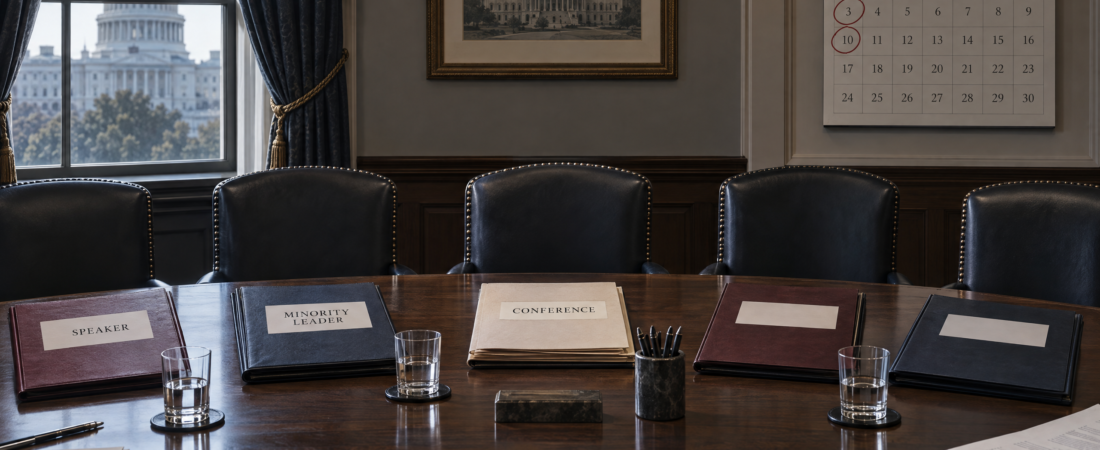
Editorial image prompt: “Editorial news illustration, not a photorealistic depiction of any real politician: an empty Capitol-style committee room with five unoccupied chairs around a conference table, folders labeled ‘Speaker,’ ‘Minority Leader,’ and ‘Conference,’ a wall calendar marked ‘Nov. 3’ and ‘Nov. 10,’ muted red, blue and charcoal palette, documentary magazine style, no faces, no logos, no fabricated event, clearly symbolic.”
Image alt text: Symbolic editorial illustration of empty House conference chairs and leadership folders ahead of the 2026 election.”