2026 midterm polling gives Democrats an edge—but not a guaranteed congressional takeover
Dek: The final national surveys point to a Democratic advantage heading into Nov. 3, while House and Senate forecasts show why the same mood may produce different outcomes in each chamber.
Meta description: 2026 midterm polling favors Democrats nationally, but House and Senate maps create very different paths to control.
Slug: 2026-midterm-polling-democratic-advantage-congressional-control
With the Nov. 3 midterm elections less than a week away, 2026 midterm polling is showing a clear Democratic advantage in national sentiment. But the numbers describe the electorate’s mood, not a ready-made seat count. The House is decided district by district; the Senate is decided state by state, on a map that still gives Republicans a meaningful structural cushion.
What the final national polls show
A Reuters/Ipsos poll reported Oct. 26 found registered voters preferring Democratic congressional candidates 47% to 36% on the generic congressional ballot. Eleven percent were undecided. When those undecided voters were asked which way they leaned, the Democratic margin narrowed to 50%-41%.
The same online survey found President Donald Trump’s approval rating at 32%, up one point from the previous week’s record low. Among voters judged most likely to vote, Democrats led 53%-44%. Reuters/Ipsos surveyed 1,679 U.S. adults, including 1,280 registered voters; its margin of error was 3 percentage points for registered voters.
The NPR/PBS News/Marist poll points in the same direction, though its screen produces a slightly different estimate. Democrats led Republicans 52%-44% among likely voters, an eight-point margin, and led by 10 points among registered voters. Marist put Trump’s approval at 40%-59% among likely voters and 38%-61% among registered voters.
Those differences are not necessarily contradictions. The surveys used different field dates, modes and likely-voter methods. Marist interviewed 1,289 registered voters by phone, text and online on Oct. 19-20. The PBS NewsHour summary also reported an eight-point Democratic lead among likely voters.
The national mood is a warning sign for the president’s party
The common thread is not simply the ballot margin. It is that voters are treating the election as a judgment on the governing party. Marist found 44% of likely voters saying their congressional vote was mainly against Trump, compared with 21% who said it was mainly in favor of him. Cost of living was the top issue, cited by 34%, followed by preserving democracy at 33%.
Reuters/Ipsos likewise found 73% saying the cost of living was moving in the wrong direction. Democrats also held an enthusiasm advantage in that survey: 46% of Democrats said they were very enthusiastic about voting, compared with 30% of Republicans. Marist found a narrower but still real enthusiasm edge among likely voters, with Democrats 71% very enthusiastic versus 61% of Republicans. Turnout remains uncertain.
Why the House looks more reachable for Democrats
The House math is comparatively straightforward. Republicans entered the campaign with a 218-214 majority, two vacancies and one independent who caucuses with Republicans, according to Reuters’ Oct. 19 election explainer. Democrats need a net gain of four seats.
The Cook Political Report’s House ratings, updated Oct. 16, listed 21 toss-ups. Its competitive list was heavily populated by Republican-held districts, including New York’s 17th, Colorado’s 8th, Ohio’s 7th, Iowa’s 1st, Montana’s at-large district and several Texas, Florida and North Carolina seats. Reuters’ district-by-district review shows how redrawn maps, candidate strength and spending can make a national Democratic margin unevenly valuable.
That is why a Democratic House win is a plausible reading of the polling without implying a sweeping landslide. The party must convert a broad national preference into narrowly distributed victories in districts where Republican incumbents may still benefit from geography and redistricting.
The Senate path is narrower and state-specific
The Senate presents a harder test. Republicans hold 53 seats to Democrats’ 47, and Democrats need a net gain of four for a majority, according to Inside Elections and Reuters’ Senate race analysis. Democrats also have to protect their own competitive seats, especially Georgia, Michigan and New Hampshire, before adding four Republican-held states.
The most discussed pickup opportunities are Alaska, Iowa, Maine, North Carolina, Ohio and Texas. Recent state polling illustrates the challenge and the opportunity. In Ohio, Marist found Sherrod Brown ahead of Jon Husted 48%-44% among likely voters, but the same poll found Ohio likely voters expecting the Republican congressional candidate to win the generic House race. National sentiment can coexist with ticket splitting.
The Associated Press Senate race guide describes the basic Democratic sequence: hold all 13 Democratic-held seats up for election, then flip at least four of 22 Republican-held seats. That is a demanding chain. A small polling error, a turnout imbalance or a candidate-specific problem in one state can break it.
What remains uncertain before Nov. 3
The confirmed fact is a national Democratic advantage across the latest Reuters/Ipsos and NPR/PBS/Marist surveys. The forecast is more conditional: nonpartisan ratings make the House more attainable for Democrats than the Senate, while several Republican-held Senate states remain in play.
The final result will depend on turnout, undecided voters, state-specific preferences and whether national dissatisfaction with Trump translates into a vote for the opposing party rather than abstention or a split ticket. Until those ballots are counted, the most accurate description is not “Democratic takeover,” but Democratic advantage with two very different paths to control.
Sources
- Reuters/Ipsos, “Trump approval rises from record low to 32% ahead of midterm election” — Oct. 26 national poll results and methodology.
- Marist Poll, “U.S. Midterm Elections, October 2026” — NPR/PBS News/Marist national results and methodology.
- NPR, “Democrats still poised to make gains, but poll shows warning signs” — interpretation of likely-voter, enthusiasm and turnout findings.
- PBS NewsHour, “Poll gauges voter enthusiasm for both parties a week before election” — broadcast summary of the Marist findings.
- Cook Political Report, “2026 CPR House Race Ratings” — district-level House ratings, updated Oct. 16.
- Inside Elections, “Senate” — Senate balance, majority threshold and projection.
- Reuters, “Races that will decide control of the U.S. Senate” — state-by-state Senate battlegrounds.
- Reuters, “Ten key US House races that could decide the 2026 elections” — district-level examples and redistricting context.
- Reuters, “What you need to know about the 2026 US midterm elections” — current chamber composition and control thresholds.
- Associated Press, “Senate races to watch in the 2026 midterm elections” — Senate map and state-level control path.
- Marist Poll, “Midterm Elections in Ohio, October 2026” — state-level Senate and congressional-ballot findings.
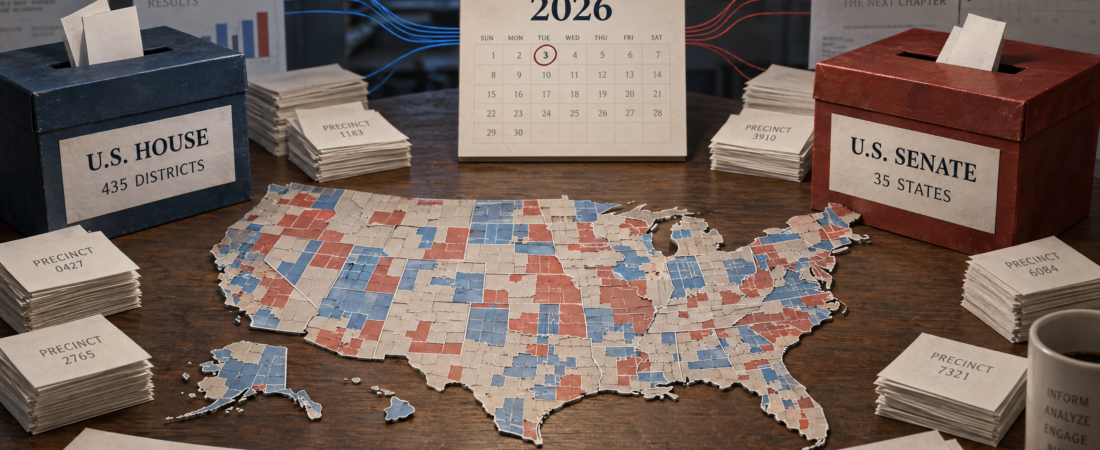
Editorial image prompt: Create a horizontal, documentary-style editorial illustration of a U.S. election map made from paper precinct cards and two ballot boxes labeled “House districts” and “Senate states,” with red and blue statistical lines converging toward a calendar marked “Nov. 3, 2026.” Use subdued newsroom colors, realistic paper texture, and small neutral labels such as “national mood,” “district map,” and “state map.” Do not depict any real politician, recognizable face, fabricated rally, or invented event; clearly present it as a symbolic illustration.
Image alt text: Symbolic editorial illustration of 2026 midterm polling, with paper election maps, House district cards, Senate state cards and ballot boxes leading toward Election Day.