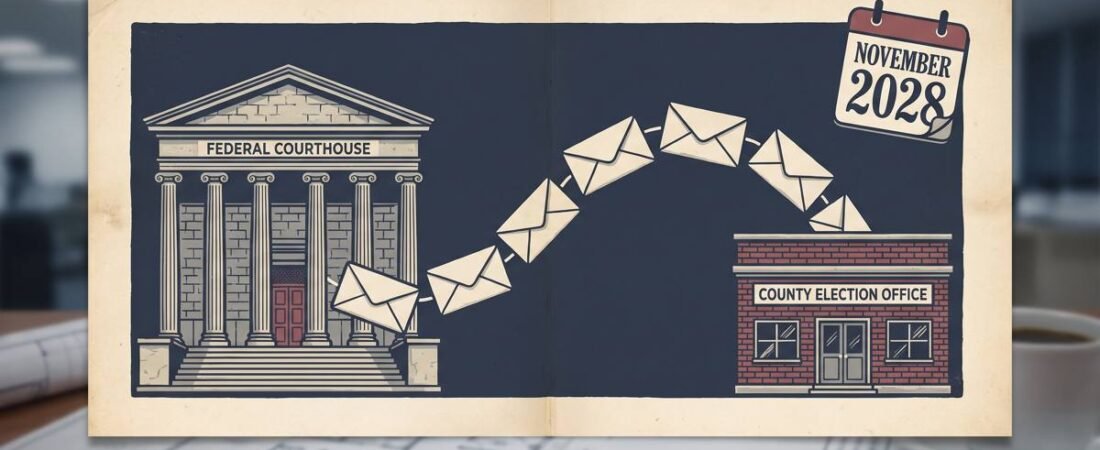
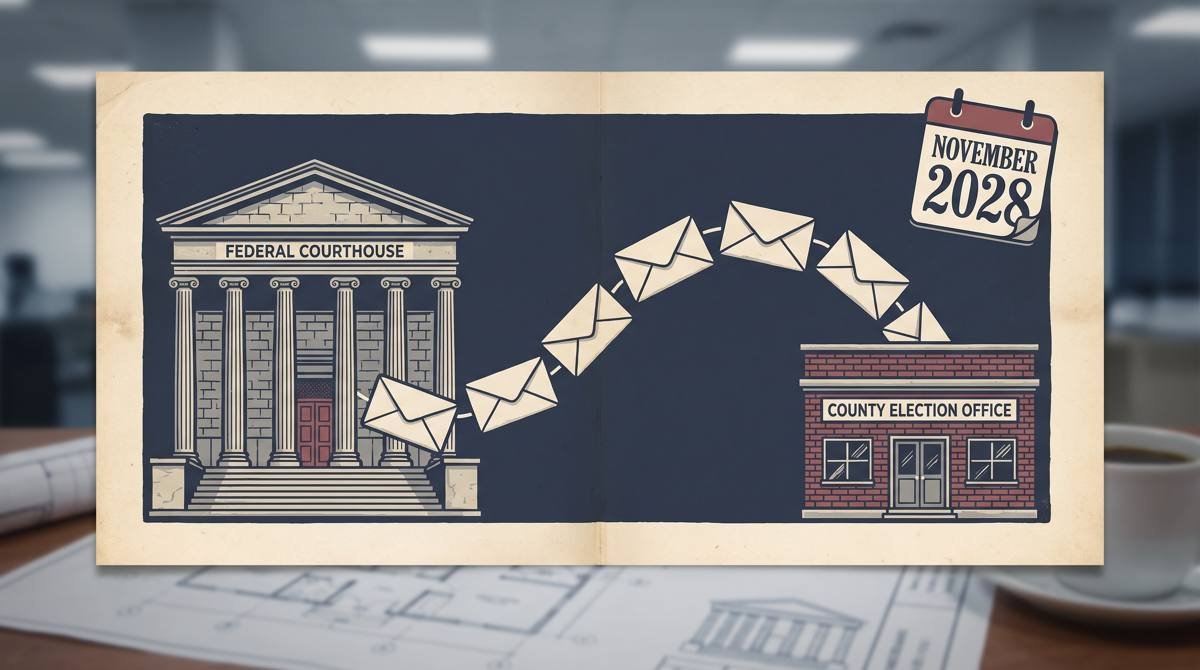
Twelve Republican state attorneys general have begun an appeal aimed at reviving the Trump administration’s contested mail-ballot restrictions for the 2028 federal election. The filing does not restore the rule. It starts another stage of litigation over whether the U.S. Postal Service can require states to provide voter and ballot information before it delivers federal election mail.
The case is distinct from the emergency litigation that affected the 2026 midterms. A September injunction by U.S. District Judge Carl Nichols blocks the Postal Service rule for federal elections generally, including 2028. The Republican officials’ appeal keeps that injunction in dispute while the underlying case proceeds. As of November 16, 2026, no appellate ruling reinstating the rule has been reported in the sources reviewed.
As of November 16, 2026.
Facts: What the states appealed
NPR reported that the attorneys general for Alabama, Florida, Indiana, Kansas, Louisiana, Missouri, Montana, Nebraska, Oklahoma, South Carolina, South Dakota and Texas filed the process of appealing Nichols’ September order on November 12. The appeal challenges a preliminary injunction in the District of Columbia case. NPR’s November 13 report said the states are seeking to revive the administration’s mail-voting restrictions in time for 2028.
The contested rule was issued by USPS in August. The Federal Register notice describes a system for federal ballot mail that included mail-preparation and data-reporting requirements. The rule’s central mechanism would have required states to provide names and addresses of voters using federal ballot mail. NPR reported that delivery under the new system would have depended on compliance with those requirements.
Nichols’ September 13 opinion found that the Postal Service likely exceeded its statutory authority. The published court opinion says the rule would create a federal ballot-mail portal, require state election officials to enter voter and ballot-identification information, and make outbound federal ballot mail contingent on that system. The judge wrote that the Postal Reorganization Act did not clearly authorize USPS to impose new election procedures on states, create that data system or refuse to transmit lawful mail because the data requirements were not met.
The injunction was broader than simply blocking USPS from refusing a noncompliant envelope. Nichols concluded that leaving the rest of the system in place could force states to redesign envelopes, obtain Postal Service approvals and build the portal, creating delays and confusion even if USPS could not reject a ballot. The opinion therefore enjoined the rule in its entirety as to the plaintiffs, while describing the remedy as party-specific under then-governing Supreme Court precedent.
Facts: Why the 2026 midterm case matters to 2028
The administration had sought to put the rule into operation before the midterms. A separate Massachusetts case produced another injunction, and the Supreme Court declined in September to pause that order for the 2026 election. NPR reported that the Supreme Court’s decision left the 2026 rule unenforced, while Nichols’ order reaches federal elections beyond this year.
The Postal Service’s public election-mail guidance continues to describe official election mail, including ballots and absentee applications, without announcing implementation of the disputed portal requirements. That page is general guidance and does not resolve the appeal. It should not be read as a final judicial determination or as proof that the rule has been permanently withdrawn.
The 2028 election is still more than a year away. The appeal therefore concerns future administration rather than a rule currently being used to count 2026 ballots. It also does not itself decide whether states must adopt particular identification, registration or ballot-return rules; those questions remain governed by separate federal and state statutes and litigation.
Analysis: What an appellate ruling could change
If an appellate court reverses or narrows the injunction, USPS could seek to implement some version of the rule before 2028, subject to further proceedings and any revised instructions. State election offices would then have to determine how to transmit the required data, protect voter information and meet federal ballot-mail deadlines. The operational question would be especially important for overseas and military voters, whose ballots depend on predictable delivery windows.
If the injunction stands, the Postal Service would remain unable to enforce the challenged data and mail-preparation regime unless Congress changes the law or a different legal theory succeeds. That would preserve the pre-rule system while leaving open the administration’s broader arguments about election integrity and federal control of election mail.
The dispute also illustrates why procedural status matters. A preliminary injunction is not a final judgment on the merits. It means the judge found a sufficient likelihood of legal and practical harm to pause the rule while the case continues. An appeal can change that posture, but a notice of appeal is not a ruling. The states’ political alignment may also shift: NPR noted that Democratic candidates are set to take the attorneys-general offices in Texas and Kansas in January, which could affect whether those states continue pursuing the case.
Supporters of the rule argue that a standardized federal system could help USPS identify mail associated with federal elections and enforce consistent handling requirements. Opponents, including the plaintiffs in Nichols’ case, argue that Congress did not give USPS power to create a voter-information registry or condition delivery on state compliance. The record reviewed here does not establish that the rule would have prevented fraud, nor does it establish that the injunction itself improves or harms election security. Those are policy claims that require evidence beyond the existence of the litigation.
The immediate verified development is narrower: twelve Republican-led states have appealed a ruling that currently blocks the USPS ballot-mail rule for the 2028 federal election. The next meaningful change will come from appellate filings or orders, not from the appeal notice alone. As of November 16, 2026, the rule remains contested and unimplemented under the injunction described above.