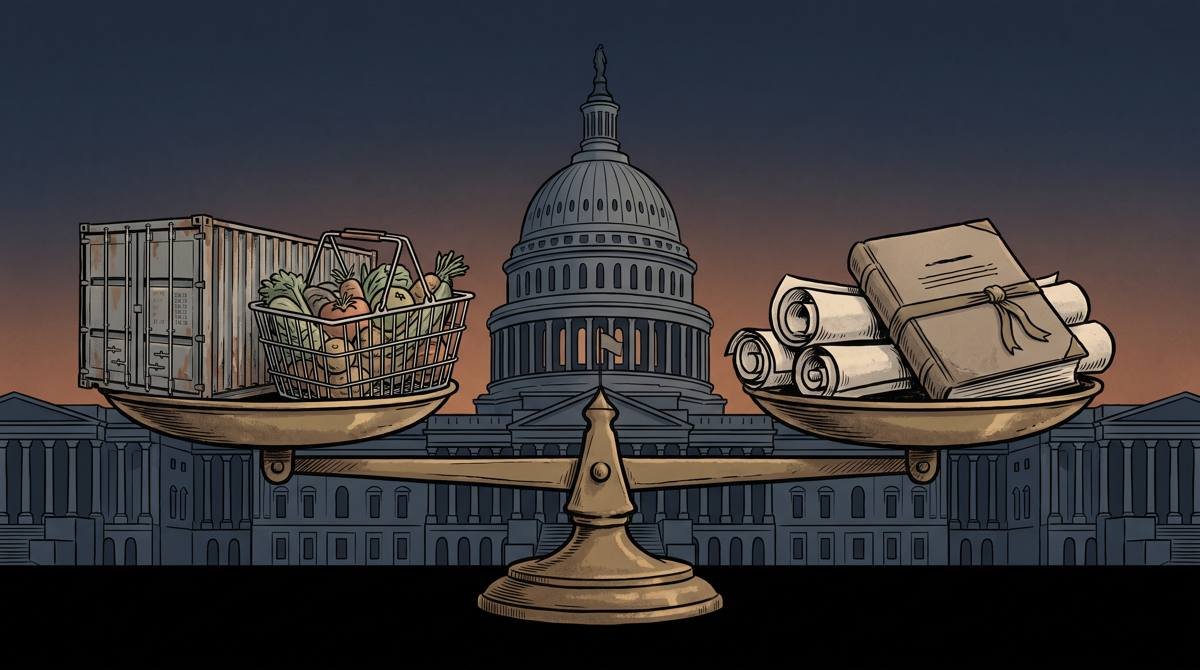
As of November 7, 2026, the most consequential economic-policy shift after the November 3 election is not a new law or Federal Reserve decision. It is the change in leverage on Capitol Hill. Democrats’ projected control of both chambers gives them greater influence over spending bills, the debt ceiling and committee oversight, while President Donald Trump retains substantial executive authority over tariffs and other trade actions. That combination sets up a governing fight over affordability, inflation and the federal budget.
The stakes are unusually immediate. The latest official data show consumer prices rising 3.7% over the year through September, while October payrolls increased by 165,000 and unemployment stood at 4.1%. The Federal Reserve has held its policy rate at 3.75% to 4%, saying inflation remains elevated. The next Congress will therefore confront an economy with solid job growth but continuing pressure on household budgets.
Facts: The election changed Congress’s fiscal leverage
Reuters reported on November 4 that Democrats’ new congressional position could give them leverage over the “fiscal purse” and the government’s ability to borrow. Those powers matter because Congress must approve appropriations and periodically raise the statutory debt limit. Failure to reach agreements could increase the risk of a government shutdown or a debt-limit confrontation, although neither outcome is certain. Reuters, November 4
The likely committee agenda is already visible. In an official November 4 statement, Senate Finance Committee Ranking Member Ron Wyden said Democrats would prioritize taxes, health-care affordability and a broader congressional role in trade policy. He said the committee would seek higher contributions from wealthy taxpayers and corporations, pursue cheaper health care and “reassert congressional authority” over trade. Those are stated priorities, not enacted policies. Senate Finance Committee statement
The distinction matters. A congressional majority can write legislation, attach conditions to funding and conduct hearings, but the president can veto bills, and trade authorities delegated to the executive branch are not automatically revoked by an election. Reuters quoted economist Christopher Hodge saying trade and foreign policy powers remain concentrated in the executive branch. Reuters, November 4
A current tariff-related proposal illustrates the limits of the immediate shift. H.R. 9768, the Tariff Refund Act of 2026, would treat certain tariff revenue as an overpayment of tax. Congress.gov lists the measure as introduced and referred to the House Ways and Means Committee. It has not passed the House or Senate and has not become law. Congress.gov, H.R. 9768
Facts: Inflation remains the political pressure point
The Bureau of Labor Statistics reported that the Consumer Price Index rose 0.6% in September and 3.7% over the previous 12 months. Energy was the largest source of monthly pressure: the energy index increased 5.2% in September, while gasoline rose 9.1%. Core prices, excluding food and energy, increased 2.6% over the year. The October CPI report was scheduled for November 10, so no October inflation figure was available as of this article’s publication date. BLS, September CPI
Labor-market conditions were stronger than the inflation figures. BLS reported that nonfarm payrolls rose by 165,000 in October, above the 48,000 average monthly gain over the prior 12 months. Average private-sector hourly earnings rose 3.1% over the year to $38.00. At the same time, 4.8 million people were working part time for economic reasons, an increase of 339,000 in October. BLS, October Employment Situation
The Federal Reserve’s October 28 statement described economic activity as expanding at a strong pace and said job gains had kept pace with the workforce. But it also said inflation remained elevated and kept the federal funds target range at 3.75% to 4%. The decision passed 10-2; Governors Lisa Cook and Beth Hammack preferred a quarter-point increase. Federal Reserve, October 28 FOMC statement
Analysis: What the next governing agenda could mean
The immediate policy question is whether Democrats use their fiscal leverage to seek changes on tariffs, health subsidies, taxes or spending, or whether they pursue narrower agreements that avoid a shutdown or debt-limit crisis. A debt-ceiling deadline is not itself a policy deadline, and the timing of negotiations can change. Reuters described the debt ceiling as a potential pressure point beginning late next year, not as an imminent default. Reuters, November 4
Tariffs are the clearest area where voter concern and institutional limits collide. Congress can hold hearings, alter funding and pass bills addressing tariff revenue or trade authority. The president, however, can continue using existing executive powers unless Congress changes the law and overcomes a veto or reaches an agreement. The result could be a prolonged dispute rather than a quick rollback. H.R. 9768’s introduced-only status underscores that proposals should not be described as relief that households will receive.
The Federal Reserve adds another constraint. Congress can oversee the central bank, but monetary-policy decisions remain with the FOMC. With inflation above the Fed’s 2% goal and the labor market still expanding, elected officials’ demands for lower prices may not translate into immediate rate cuts. Conversely, any political pressure for faster easing could conflict with the Fed’s stated concern about returning inflation to target.
The governing agenda is therefore likely to be judged on implementation, not campaign promises. Democrats can use committee control and fiscal legislation to force negotiations over affordability. Republicans and the White House can argue that tax, regulatory and trade changes should protect growth and executive flexibility. Until bills advance, agency actions are issued or negotiations produce an agreement, the post-election economic story is a shift in bargaining power—not a completed change in policy.
Sources
- Reuters, “Trump is still in charge, but Democrats gain leverage in coming economic debate,” November 4, 2026
- U.S. Senate Finance Committee, Wyden agenda statement, November 4, 2026
- Federal Reserve, FOMC statement, October 28, 2026
- Bureau of Labor Statistics, Consumer Price Index, September 2026
- Bureau of Labor Statistics, Employment Situation, October 2026
- Congress.gov, H.R. 9768, Tariff Refund Act of 2026