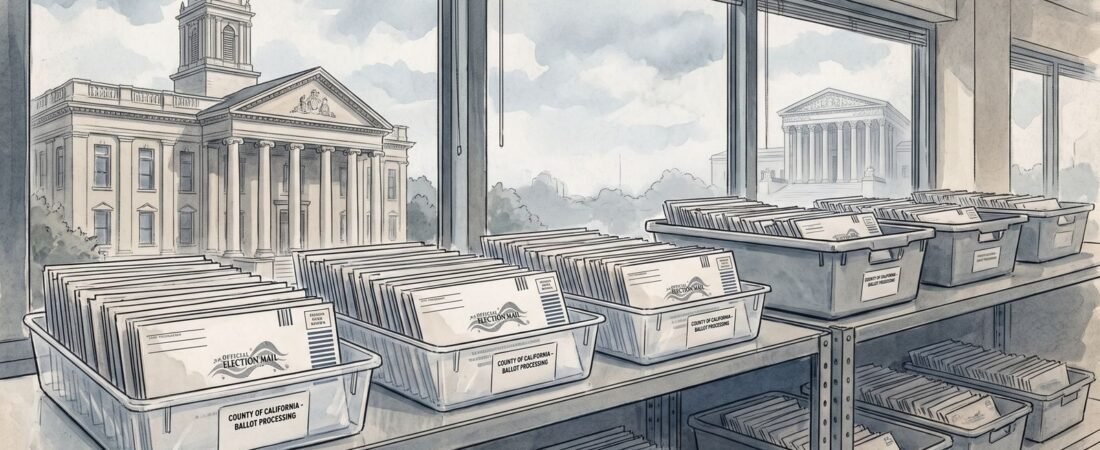
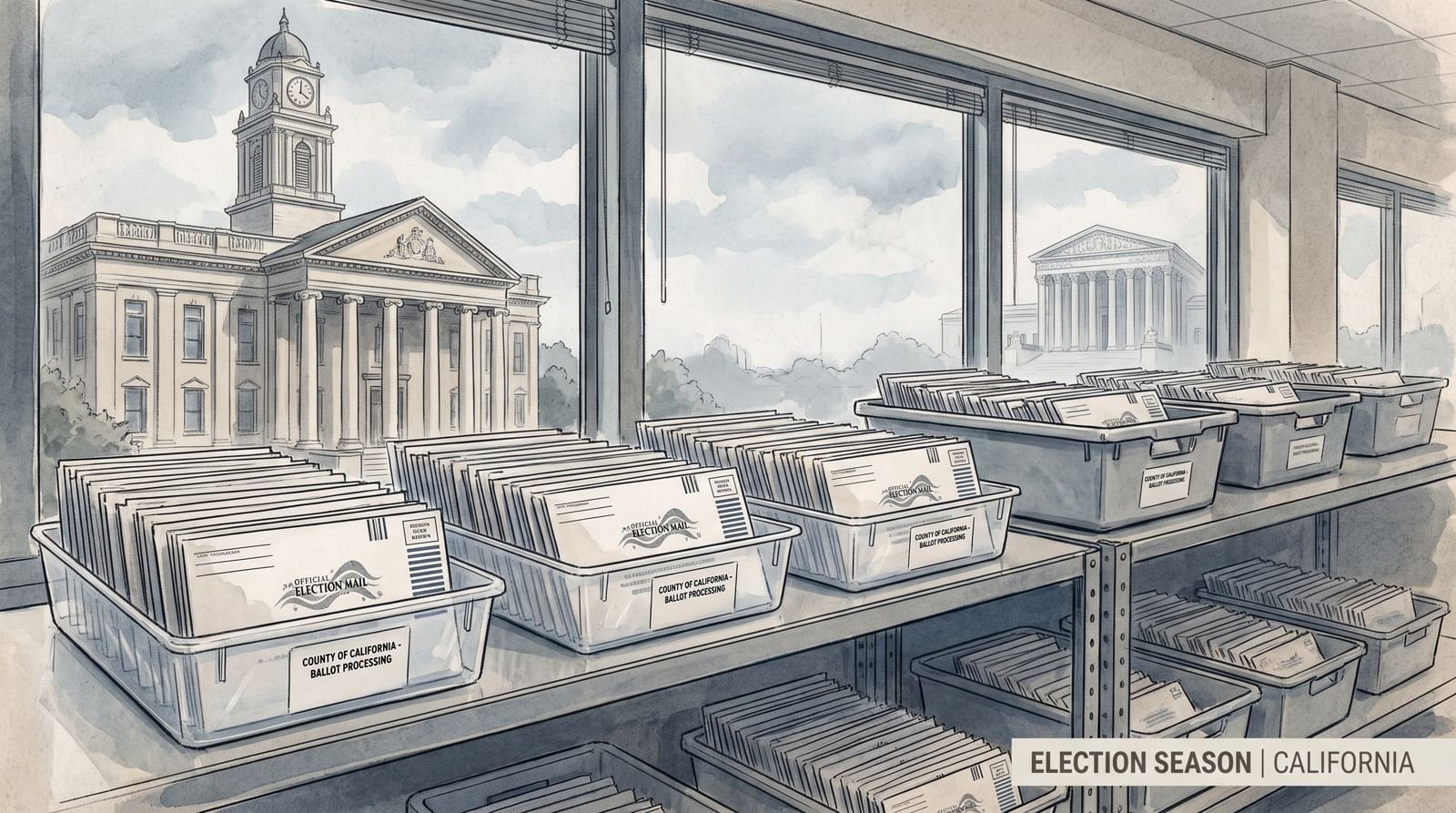
The Supreme Court on Monday rejected the Trump administration’s last-minute request to force California election officials to separate and withhold mail ballots from about 20,000 registered voters whom federal officials described as likely non-U.S. citizens. The unsigned, one-line order came hours after the Justice Department asked for emergency relief on the eve of the November 3 midterm election, leaving California’s existing ballot-counting procedures in place.
The ruling is the most consequential verified election-administration development immediately before Election Day because it tests whether the federal government can intervene in a state’s ballot-processing system based on an unverified list. It does not decide whether any individual on the list voted unlawfully, and it does not resolve the Justice Department’s underlying lawsuit against California.
Facts: What the Supreme Court decided
The court denied the Justice Department’s request for an injunction requiring California to segregate the disputed mail ballots until the voters’ citizenship could be confirmed. CBS News reported that the order had no noted dissents and that the justices acted without first asking California election officials to respond.
The administration had argued that once the ballots were mixed with other lawful ballots, they could not be retrieved. In its emergency filing, Solicitor General D. John Sauer wrote that “once California commingles the challenged ballots with lawful ones, there is no way to get the challenged ballots back.” The filing and supporting court materials are available through the Supreme Court docket in 26A624, including the administration’s application and the lower-court record.
The Justice Department’s request followed two losses in lower courts. U.S. District Judge David Carter rejected the administration’s temporary restraining-order request on October 28. The Ninth Circuit’s October 30 decision also refused emergency relief. The appeals court cited California’s election procedures and warned that granting the request could disenfranchise eligible voters and disrupt the county’s election process.
California officials disputed the reliability of the federal list. They argued that the government’s matching process could identify citizens incorrectly and that withholding ballots based on an allegation would deny voters the normal opportunity to have their eligibility reviewed under state procedures. California Attorney General Rob Bonta called the federal demand an attempt to undermine established election rules, according to Reuters’ account of the litigation.
Facts: What remains in effect on Election Day
The Supreme Court’s action means the state is not required by this emergency order to create a special pool for the approximately 20,000 ballots. California’s election officials continue to apply the state’s ordinary verification and counting rules. The ruling does not instruct officials to count an ineligible ballot. It rejects the requested federal procedure for stopping or segregating ballots before the state’s established review is complete.
California’s official election calendar says county officials began mailing vote-by-mail ballots no later than October 5. It lists November 3 as Election Day and says counties begin reporting results at 8 p.m., while the semifinal official canvass continues. Mail ballots postmarked by Election Day may be counted if received by the applicable deadline. The California Secretary of State’s key-dates page says counties must certify results by November 10, with the state’s statement of vote certified on December 4.
Those deadlines matter because the Supreme Court’s order concerns emergency relief, not final certification. Election-night totals will therefore remain unofficial, and later-arriving mail ballots and canvass procedures can change vote counts after November 3.
Analysis: Why the dispute matters beyond California
The case places state election administration and federal enforcement authority in direct conflict. Federal law prohibits noncitizens from voting in federal elections, but the practical question before the courts was whether the executive branch could require a state to set aside ballots based on a federal list before the voters’ citizenship had been individually established.
The lower courts focused on the risk of error. Reuters reported that Judge Carter described the administration’s data as unreliable and noted that people flagged in other states had turned out to be naturalized citizens. The Ninth Circuit likewise emphasized California’s existing mechanisms for canceling a registration when ineligibility is demonstrated. Those rulings did not hold that noncitizens may vote. They held that the requested mass segregation remedy had not met the standard for emergency judicial intervention.
The decision also limits the administration’s immediate ability to change how California counts ballots in this election. It does not prevent the Justice Department from pursuing its lawsuit, seeking records, or asking a court for relief after fuller briefing. Nor does it establish a nationwide rule governing every future voter-list dispute. The procedural posture is narrow: the justices denied a request for temporary relief on the eve of voting.
The political stakes are substantial. California has 52 House seats, more than any other state, and control of Congress is being contested in the midterms. But the ruling itself does not determine a race or change a vote total. Any claim that the 20,000 ballots will decide congressional control would be speculative until the ballots are reviewed, counted where lawful, and compared with the margins in individual contests.
Analysis: What to watch next
The immediate next steps are administrative and legal. Counties will continue processing ballots under California law, including eligibility checks and the canvass. The Justice Department’s underlying case remains unresolved, and further rulings could clarify what information federal officials may obtain and what remedies a court could order after the election.
The most important uncertainty is factual: the federal government’s figure identifies people it says are likely noncitizens, not a confirmed count of noncitizens who cast ballots. The Supreme Court’s order does not validate that list, reject every underlying allegation, or make a finding of widespread noncitizen voting. The verified conclusion as of November 3 is narrower: California may proceed under its existing election procedures while the broader dispute continues.
Sources
- U.S. Supreme Court docket, United States v. California, No. 26A624
- Ninth Circuit, October 30, 2026 order
- Reuters, “US Supreme Court rejects Trump, lets California count all ballots”
- CBS News, “Supreme Court rejects Trump’s effort to force California to separate mail ballots”
- California Secretary of State, 2026 general-election key dates and deadlines