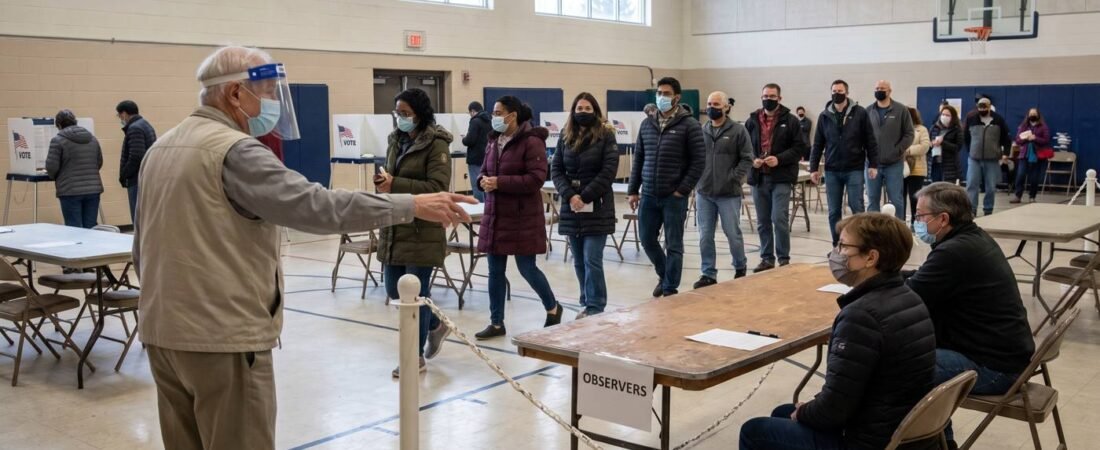
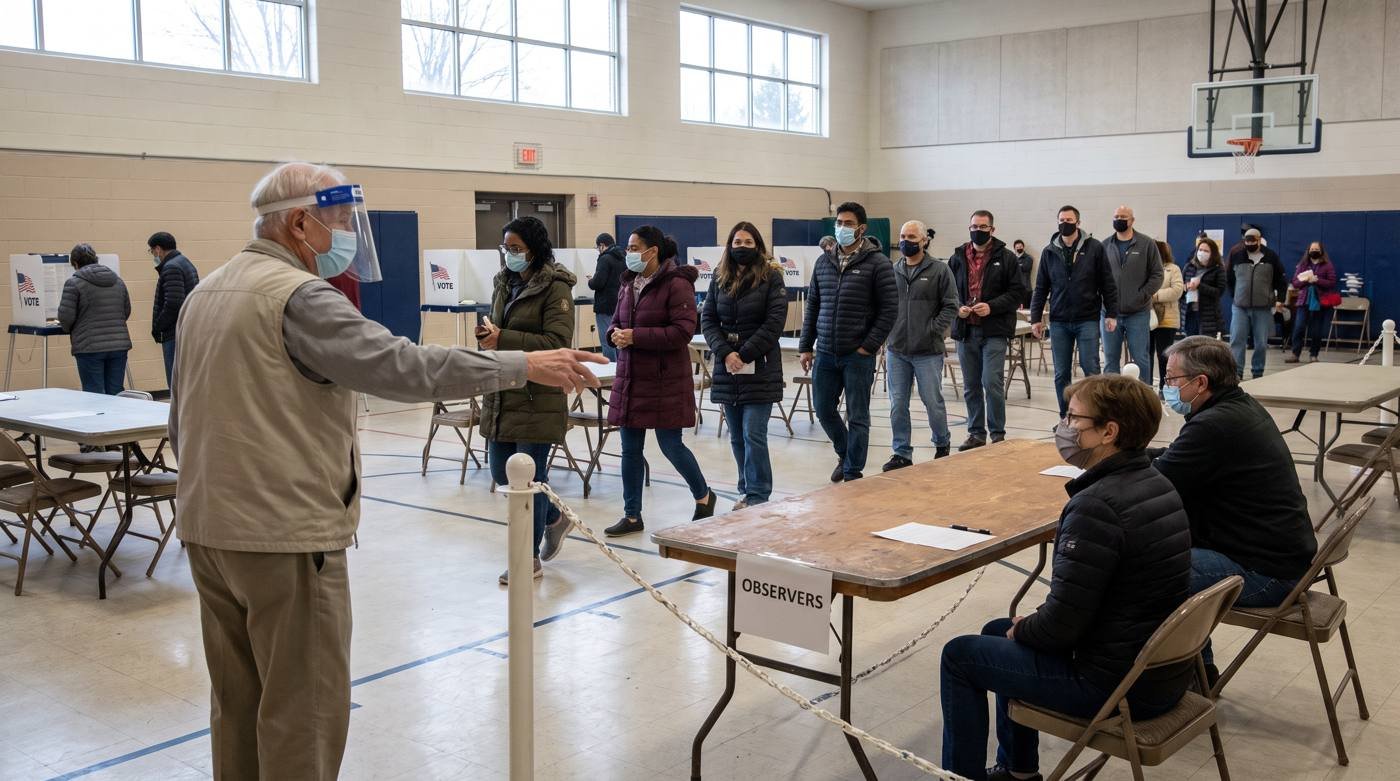
The Justice Department’s planned Election Day presence is unusually large, but its legal power at a polling place remains limited. The practical question is not whether federal officials will be visible; it is what they are legally allowed to do once they arrive.
On Nov. 3, the Justice Department plans to send more than 1,000 election monitors to all 50 states, according to PBS News and Reuters reporting. That would be more than twice the 388 people the Biden Justice Department sent to polling places during the 2022 midterms, and Reuters described it as roughly three times the last midterm total. The scale has prompted concern from state officials, especially because the deployment comes alongside federal demands for voter-registration data and a more aggressive public focus on alleged election fraud.
Fact: A larger federal presence does not give the executive branch control over how states conduct elections. State and local officials still administer polling places, count ballots and certify results under state law, subject to federal requirements.
What federal monitors are supposed to do
The traditional function of a federal election monitor is observation. The Election Assistance Commission’s overview of federal election law says federal observers may monitor whether voters face discriminatory treatment, report how election officials and voters are treated, and observe parts of the process from registration through counting.
The Justice Department says the 2026 monitors will be trained not to interfere. A senior DOJ official told PBS that they are there to “observe and report,” with enforcement action, if warranted, taking place after Election Day. Reuters reported that the department’s stated priorities include protecting access and countering voter intimidation. The monitors may document what they see, speak with voters after they leave, and refer immediate concerns to election officials or law enforcement.
That does not make every monitor’s presence automatically lawful in every location. The EAC says each state sets its own rules for when and where observers may be present. After the Supreme Court’s Shelby County v. Holder decision, the EAC explains, DOJ may send Office of Personnel Management observers where a court order or consent decree applies, or send DOJ personnel with the jurisdiction’s permission. State and local officials have therefore issued different instructions about access, distance and conduct.
What they cannot do inside a polling place
A monitor is not a poll worker, judge or local election director. The monitor cannot decide whether a voter is eligible, order a poll to close, seize voting equipment, direct the count or change a state’s ballot rules. Reuters reported that monitors cannot conduct investigations on the spot or stop someone from voting. In the Northern District of Ohio, the U.S. Attorney’s Office similarly said state and local police have primary jurisdiction over polling places, particularly in a violent or intimidation emergency.
The line matters because the presence of federal lawyers can feel coercive even when they are standing back. Reuters reported that the administration is using prosecutors as monitors, departing from a long-standing practice of relying mainly on civil lawyers and support staff. DOJ says the personnel will not identify themselves as prosecutors and will not personally prosecute a violation they observe. Critics, including the NAACP in litigation reported by Reuters, argue that prosecutors may intimidate voters simply by being there.
Analysis: The legal limit is clearer than the political effect. A monitor may be unable to intervene at the check-in table, yet the monitor’s notes can influence a later investigation, lawsuit or public claim. That makes accurate documentation—and clear separation from election workers—especially important.
How the voter-roll subpoenas fit in
The monitoring plan is part of a broader federal campaign to obtain and examine voter-registration data. PBS reported that the administration had issued more than 100 subpoenas to more than a dozen states. In a Justice Department announcement, the agency said it had sued five additional states for not producing full voter-registration lists, bringing its stated total to 29 states and the District of Columbia. DOJ said the Civil Rights Act of 1960 gives the attorney general authority to demand, inspect and analyze statewide lists.
That authority is about records and possible enforcement, not an Election Day citizenship checkpoint. The DOJ official told PBS that monitors are “not out there checking citizenship status before people go to the polls.” A voter’s appearance, name or language is not proof of citizenship status, and a list match is not by itself proof that an illegal vote was cast.
The EAC’s explanation of the National Voter Registration Act says list maintenance is a normal process, but it must be uniform and nondiscriminatory. It also says general list-maintenance programs that remove registrations must be suspended 90 days before a federal primary or general election, with limited exceptions. The practical safeguard is due process: identifying a possible problem is different from removing an eligible voter or rejecting a ballot.
Why certification is not decided at the polls
Election-night totals are not final results. The EAC’s canvass and certification guidance says officials reconcile mail, early, Election Day and provisional ballots during the canvass. Most states also conduct a post-election audit, and some contests may go to a recount under state law. Only after those steps do officials issue a written certification.
Certification authority varies. A local board or official may certify at one level, while a secretary of state, governor, election director or state board certifies at another. A federal monitor cannot substitute a personal assessment for that process. If an official refuses to perform a mandatory certification duty, the dispute generally moves to state enforcement or court proceedings rather than being resolved by a monitor’s declaration at a polling place.
This layered process is also why an allegation observed on Nov. 3 does not automatically invalidate votes. A credible complaint can lead to an investigation, litigation, a recount or a correction. It still must be supported by evidence and handled under the law.
What the public should—and should not—conclude
The planned deployment can increase documentation of access problems, intimidation and compliance with federal voting-rights protections. It can also create confusion if observers are mistaken for election workers or if isolated irregularities are presented as proof of widespread fraud.
Available evidence does not support claims of rampant noncitizen voting. PBS’s election-security review described such voting as extremely rare and noted that statistical claims of mass manipulation failed expert scrutiny. That does not mean no election violation can occur. It means the burden is to establish a specific violation with specific evidence, not to infer a national pattern from a rumor, a database discrepancy or a monitor’s presence.
The bottom line is straightforward: DOJ monitors can watch, record and report within the rules set by law and local officials. They cannot run Election Day, remove voters on the spot, command a count or unilaterally block certification. For voters, the strongest safeguard remains the ordinary one—follow instructions from trained local election workers, report concrete intimidation or access problems through the proper channels, and wait for the canvass, audits and certification before treating preliminary claims as final.